Showing posts with label bbc. Show all posts

Sunday, 15 April 2018

Wallace and Gromit: The Wrong Trousers

Channel: BBC/ Amazon Prime

Running Time: 30 minutes

Date: 1993


Britain's only hope.

Premise: Wallace is a man, and Gromit is a beagle. But you knew that already. Apart from the beagle bit, perhaps, because I always just classified Gromit as 'dog'. This is the Oscar-winning instalment two of the Wallace and Gromit series, following the Oscar-nominated A Grand Day Out (1989). There is no prior knowledge needed to enjoy this one, however, with only the spaceship models on the wall serving as a visual reminder of continuity. They live in Wigan, but essentially it's generic Lancashire, or, for those of you from south of say, Lancashire, it's 'The North'.  Running up large debts, Wallace is forced to take in a lodger, at the same time Gromit gets some Techno-Trousers for his birthday, allowing automated walkies and vacuum-feet for walking up walls. The lodger is a sinister penguin, who drives a wedge between Gromit and Wallace - commandeering Gromit's cosy bedroom, sycophantically fetching Wallace's slippers and newspaper, and leaving his music on till the late hours, disturbing Gromit's sleep. Gromit leaves home, tearfully.


Trousers - not yet the wrong ones. 
The second act sees the melodrama turn to crime-thriller, as you probably already know, but if you don't, I'll just say 'diamond heist', 'modified helmet' (lol) and 'train chase', and you know enough. Of course, the most wonderful aspect of this film is that it was shot using stop-motion animation, which involves 24 separate frames being shot for each second of animation. An interesting comparison is that of Paw Patrol, where this ratio is reversed, and it takes one second of cerebral activity to create 24 episodes.

Before the franchise really took off, this is a reminder of the more humble origins of the duo - the convoluted inventions of Wallace extend no further than the bed-tipping machine, utilised in a perfect rule-of-three across the course of the story, whilst the final line is a perfect come-down from the chaos of the train chase: "Ooh, I do like a bit of Gorgonzola" - a resolution as perfect as "I think this is the beginning of a beautiful friendship" or HYPERLINK "https://www.youtube.com/watch?v=c_WkyalPOEI" "Tomorrow is another day!"


The eponymous trousers: reprise.

Background: The story of The Wrong Trousers is really the story of Nick Park, the creator of the duo and director of this film. He spent seven years bringing Wallace and Gromit to the small screen in their first adventure; A Grand Day Out was only beaten by Creature Comforts to the Best Animated Short Academy Award, which was another Nick Park creation, and from the same studios: Aardman Animations. The difference between the first and second offerings are stark: A Grand Day Out is noticeably rougher around the edges - fingerprints on clay, jumpier animation - but no worse off for it. But The Wrong Trousers has the mark of a big studio, higher production values, and a bigger staff.

The original, and clearly wrong, Wallace and Gromit.

If you are familiar with the stories that Courtney Cox and Jennifer Aniston were originally going to play each others' roles in Friends, as were John Le Mesurier and Arthur Lowe in Dad's Army, then you'll not be shocked to hear that Wallace and Gromit similarly evolved from a rather different conception. Wallace might have been called Jerry, and had a moustache; Gromit might have been a cat, and even when he became a dog, he might have been voiced. Even the smallest factors altered integral parts of the W&G aesthetic, as Park describes: "When Peter Sallis, who voices Wallace, said "No cheeeese, Gromit" for the first time, I realised how wide and toothy I was going to have to make Wallace's mouth."

For the iconic train chase, Park explains the methodology, in a quotation worth repeating in full:

"The train chase is something I'd never seen done before in stopframe animation. None of us knew how to do it – or even if it could work. In Tom and Jerry chases, you used to get the background whizzing by and repeating itself, so we tried the same. We built a 20ft long living room wall, 2ft high, and fixed the camera to the train, and filmed on a long shutter speed so the background looked blurry. It was quite a feat."


Something to do with shutter speeds makes this frame very clever.

Quite a feat indeed, Mr Park. There is an interview with Aardman's co-founder David Sproxton where he explains this in a bit more detail - I don't understand a lot of it, but, as with everything W&G related, it is wonderful to hear passionate people talk passionately about how they make wonderful things.

It is held in such high esteem that it is one of only three films made in 1993 to get a 100% approval rating on Rotten Tomatoes, and came 18th in the BFI list of the best British TV programmes ever. Ever. Above The World At War, for heaven's sake.

Entertainment:  It is tempting (and accurate) to class The Wrong Trousers as the zenith of the Wallace and Gromit series; although the train chase is the headline-grabber, other aspects of the story fly under the radar: Gromit's stalking of Feathers McGraw is pitched perfectly with terrific shadow work, and music by Julian Nott (more of which anon).

The comedy is also spectacular, and largely comes about not through Peter Sallis's tour de force as the only speaking actor, but in Gromit's eyebrow work, and his occasional forlorn looks to the camera. The dismissive look he gives Wallace after he asks, innocently enough, 'how were the Techno-Trousers?', is worth an acting Oscar in itself, and working with teenagers for a living, I know all about dismissive eyebrows. The fourth wall breaking, which could jar, is nice and subtle, and makes the audience see everything through his eyes to an extent.


Eyebrows: Underrated. Unless you're a teenaged girl, in which case they are overrated.


It is, perhaps, a little bit unfair to make comparisons with mass-market, mass-production television, but I'm going to anyway. The appeal of television such as W&G is the fact that you can see the fingerprints on the plasticine, literally and metaphorically. A number of people put their heart and soul into this work, a lot of the time not even knowing how or whether it would work. A classic example of a group of people working for the love of their craft rather than for money or prestige, but ending up with a stonking great pile of both anyway.

Nick Park with animator Steve Box: tiny men with normal-sized bow ties.

Ratings:

Sex: The first two episodes of W&G are short on romance, which is possibly why they work a little better than the subsequent two. Although it's nice to see that Gromit isn't entirely disinterested in the charming Fluffles in A Matter of Loaf and Death, it's a bit weird, and I don't think anyone's favourite part of A Close Shave was Wendoline. So, aside from Wallace's spotty boxer shorts, nothing to see here. (1/10)

Music: A massive triumph. The theme is one of the most uplifting sounds in existence, and the fact that my two-year old sings it is a massive bonus. You can access the full suite here, and the main theme is familiar to everyone, but the train chase is a masterpiece from start to finish.  Julian Nott returns to add to his work from A Grand Day Out, and it seems a bit of a shame that he is not more of a household name. He shouldn't be short of a few bob, though, having penned the massively successful Peppa Pig theme, too. (10/10)

Plausibility: Part of the reason W&G resonate so much with viewers is their ordinariness, rather than their extraordinariness. Cheese, tea, knitting, tinkering: these are some of the most 'British' signifiers you can mention before you start sounding like a Nigel Farage stream-of-consciousness (this blog is assuming Wallace voted for Brexit, Gromit to Remain). Although the plot itself is quite dramatic, there is a pleasingly nostalgic feel to the exterior shots - red-brick terraces, old metal dustbins and such - and the familiarity of Peter Sallis's voice from decades of The Last of the Summer Wine adds a comforting reassurance. Pleasingly high levels of verisimilitude for a show with an anthropomorphic dog and penguin. (6/10)

Education: Tricky. Objectively, there is actually the worrying lesson that you are right to be suspicious of shadowy strangers entering your neighbourhood, and you half expect Wallace and Gromit to turn to the camera at the end and say "No more 'lodgers'! They're more trouble than they're worth! Vote UKIP."


'Lodgers': more trouble than they're worth.

As for the Rube-Goldberg machine - Wallace's alarm clock bed is taken to extreme and unnecessary elaboration in A Close Shave and A Matter of Loaf and Death - but you only need to look at this guy to see that there are always people in this world who are going to be inspired to be as silly as possible for the minimum pay-off. (6/10)


A prototype from the Cameron government to try and prise benefits claimants from their beds.


Overall: Literally no-one dislikes Wallace and Gromit, and in these uncertain and volatile times, they are as dependable and comforting as a mug of tea, shards of Cadbury's Easter Egg chocolate, a hot water bottle, and a duvet, rolled into one (not literally of course; you'll make a big mess). Quite simply, one of the cultural triumphs of the whole of the 20th century, and that century included the Naked Gun trilogy. Seriously though, it's perfect. (10/10)

Wednesday, 1 November 2017

Go Jetters!

Channel: CBeebies

Running Time: 11 minutes

Date: 2015- present

Noses: Difficult to animate.

Just a quick pointer - you can read all my previous blogs, including In the Night Garden, Postman Pat SDS, The Furchester Hotel, Teletubbies, Bing, Raa Raa and Hey Duggee! at this link. 

Premise: "Training with the Go Jet Academy, four explorers on a global adventure: Xuli, Kyan, Lars, Foz. They are... the Go Jetters!" If you're a fan of asyndetic listing you're already hooked, but... cue disco music, and what could possibly be - and I'm going out on a limb here - the most catchy children's theme tune at least this century. Not the best. But maybe the catchiest. We'll come to that 'Academy' bit soon, but for now I'll run you through a typical episode.

The Go Jetters begin on the 'Jet Pad' - a big rocket ship with no visible polluting emissions, that zooms around the world, visiting spots of geographic significance. A disco-dancing unicorn - Ubercorn - talks them through said landmark with some 'funky facts' which are less 'funky' than 'rudimentary', but hey, alliteration. At the moment it sounds like Elon Musk's SpaceX programme has branched out into selling tame but expensive gap year experiences, so they've added some jeopardy - some very consistent jeopardy - in the form of Grandmaster Glitch and his Minions Grimbots. Consistent meaning every single episode. Grandmaster Glitch is the foil to our Go Jetters - a bit like The Hood in Thunderbirds, but completely useless and far less malevolent. Kind of like of Michael Gove (smug, narcissistic, all-round appalling human being) crossed with Barry Chuckle (clumsy; big moustache).

Grimbots/Not Minions: someone probably should have been sued by now.

Ultimately, our heroes are tasked with saving the geographic landmark, and usually some tourists as well. They race off, Thunderbirds style, to their sister ship, the 'Vroomster', which you need to see written down, because it sounds just like the 'Broomster', Harry Potter's latest Firebolt model at time of going to press. At the moment where we think all is lost, deus ex machina is invoked by the storytellers, as somehow, Ubercorn is able to transpose some helpful kit literally into the arms and onto the backs of our academy trainees. And, whether it be the Easter Island statues, the White Cliffs of Dover, the Eiffel Tower or the Great Wall of China, the day is saved. Grandmaster Glitch is foiled and humiliated, but rarely injured, and never killed. The Go Jetters gather for a congratulatory selfie, because 21st century. 

Click-ons: These literally appear out of nowhere.

Background: Although you might have missed the opening episode from October 26th 2015 because you were hungover from celebrating Jimmy Morales' presidential victory in Guatemala, you have certainly not had the excuse to miss it since, with over 60 episodes made in the last two years. It is regularly broadcast in the 'Oh crap is that the time!' slot on CBeebies.

Although President Morales might have thought his election victory the more significant event, history seems to have favoured Go Jetters' fortunes rather more. Earlier this autumn, the producers of the BAFTA-nominated show were rolling out series two with triumphant trailers all across CBeebies, whilst Morales was receiving criticism from the UN, and was in danger of having his immunity from prosecution withdrawn in light of damning accusations of illegal donations to his political party, the National Convergence Front. 


President Jimmy Morales incorrectly answers the question: How many Funky Facts does Ubercorn offer each episode?


Apparently the animation programme the producers use, Corona Renderer, is all very clever and everything, and you can read a glowing tribute and interview on Corona Renderer's website, if that's your bag, but having waded through it myself, it's a bit heavy on tech-speak and not very helpful if you're trying to investigate the Go Jet Academy's financial accounts, and how much funding is being diverted from other academies in the local education authority area.

As yet there has not been one single episode of Go Jetters based in Guatemala.

Entertainment: You've got to hand it to the writers: there is a lot to be said about repeating a very simple formula over and over again, changing very little other than the location - something the owners of Formula One and the tour managers of the Rolling Stones know to their bank balances' immense credit. The 'funky facts' can sometimes border on the simplistic (Loch Ness is very deep, the Pyramids of Giza are very old), but there is definitely some varied 'tainment' to be had in this very knowing  'edutainment' series, even if most of it has been borrowed from Thunderbirds.

This unicorn did a LOT of Mary Jane back in the day

One disappointment lies in the catchphrases of each character. Xuli's 'not cool' is barely even a catchphrase; Kyan's 'aced it' smacks of self-serving superiority; Foz's overuse of 'ergo' implies a young man who very much learns each new word through a subscription to Clever Club; and finally, Lars' 'Geographic!' is so wantonly tragic it forces me to reconsider the virtues of bullying. Glitch's 'Grimbles!' is by far the most quotable in real life, though I sense an ironic use for #Geographic one day in the (quite distant) future.

Although there are countless #geographic! and historically significant sites still to be mined for story ideas (keeping fingers crossed for the Doncaster Frenchgate Shopping Centre episode!), one cannot escape the feeling that Go Jetters are going to have to do something out of the ordinary pretty soon. Perhaps some spin-offs - follow the characters during their boozy 18-30 holidays, commission a prequel series charting Ubercorn's harrowing addiction to cocaine in the early 1980s, or jump on the bandwagon with a Stranger Things crossover, where the Go Jetters have to rescue the Great Barrier Reef from The Upside Down, only to discover that it fared better in a world of death and decay than in real life.
The Great Barrier Reef in the Upside Down - and the Right Way Up. #newsflash we're all screwed.


Fans of disappointing arts and crafts can learn how to make a Grandmaster Glitch moustache/eyebrows combo here, using straws, card, tape, and a world-weary resignation.
Hard to believe, but this is not actually Grandmaster Glitch.

Ratings:

Sex: These gap year students seem to be all about the geography. A quick peek inside Lars' room suggests they are all equipped with single beds; their skin tight Lycra leaves everything to the imagination. The possibilities of the disco soundtrack are lost on them. Expect to see them at a Young Conservatives event in ten years' time. 1/10

Just room for a single bed, but still bigger than any affordable flat in London. 

Music: No-one can deny the power of that theme tune. It is hard to tell what came first - the focus on geography or the focus on disco. Barry Gibb would be proud of this one. 8/10

Plausibility: As with its CBeebies cousin Octonauts, there is a nagging question of where these students' funding comes from. The Go Jetters themselves appear to be the only four students at this academy, and command a set of intricate machinery that even Jeff Tracy would have thought flashy and extravagant. This, readers, is why we 'can't afford' pay rises for nurses.

Fans of rules and regulations - and god knows I'm one - will notice Xuli's insistence every episode of always reminding the Go Jetters to fasten their Vroomster seat belts only after the countdown for lift-off has concluded. Bearing in mind she's the one who's going to be in trouble in the event of an insurance claim, I'd make sure Lars, Foz and Kyan are safely belted before I even turn the engine on. 2/10

Education: This show is up there with 'Do You Know' and 'Horrible Histories' in terms of its wider value to the education of young people. Dr Paula Owens, consultant to the series, has said "Geography is about so much more than where places are and what they are called...It helps explain how everything we do has a bearing on other people, places and environments - for good and bad." I would suggest the carbon emissions of four students flying across the world in a rocket ship definitely goes in the 'bad' column here, but maybe that Jet Pad runs on good intentions. 'Funky Facts' though, is definitely something I'd add to some of my favourite shows - Breaking Bad had a lot of things going for it, but a top three on crystal meth would have filled in some context. I'd also have liked to have seen characters in The Wire introduced in this way. 8/10


Overall: It's more Go Jetters than No Jetters, but patience is wearing thin. There's only so many times Lars can say 'It's heading straight for those tourists!' before the words lose all meaning. 6/10

Monday, 24 July 2017

Hey Duggee!

Channel: CBeebies

Running Time: 7 minutes

Date: 2014- present

Early spoiler: this show is much, much better than it looks...


Premise: A series of anthropomorphic animal characters regularly attend a kind of after-school/day care style club: The Squirrel Club (though it appears that few, if any actual squirrels attend). Said club is run by the eponymous hero, Duggee, a large cuddly dog who only ever says 'Woof!', but has obtained the requisite paperwork to look after a number of young children in a variety of indoor and outdoor settings. Imagine Hodor as a Cub Scout Leader, and you're about there.

The Clubhouse: building and owner presumably up-to-date with all current Ofsted requirements

Each episode, the Squirrels earn a badge of some kind, related to the activity or challenge or problem that has been thrown their way in that episode. Some are more mainstream (the Drawing Badge, the Rescue Badge and the We Love Animals Badge), some are quite niche (the Omelette Badge, the Dancing Bug Badge) and some are just so 21st century (the Yoga Badge). Yet to be confirmed for series three are the Brexit-Means-Brexit Badge, the Safe-Sexting Badge, the Fidget-Spinner Badge, and the badge for big fans of 1990s episodes of Neighbours (the Madge Badge).

Some of the badges available to the Squirrels; also a range of attractive yet affordable coasters.


A cast of regular and minor characters keep things fresh and bouncy, such as the hippy Rabbits, and my personal favourites, the gangster mice (catchphrase upon departing a scene "Let's Bounce!", popularised in an early draft of Romeo and Juliet; Shakespeare eventually went with "Hence, be gone, away!")

The animation is minimalist but colourful; the plots are imaginative without slipping into 'zany', or zany's idiot cousin, 'wacky'; and the voice talent ranges from the subtle youngsters (learn a lesson, Bing), to the instantly recognisable (Alexander Armstrong, currently running out of digits to place into so many pies).

Background: Creator Grant Orchard of Studio AKA explains a lot in this comprehensive interview. He has a background in Flash animation and advertising, and clearly has affection for the aesthetic and the tone of the show. He is also one of the few people who goes out of their way to put a lot of their success  down to luck, which gives him bonus points.
He was asked to pitch an idea, he came up with some of the characters, and the rest, as they say, was developed over a consequent series of brainstorming sessions, animation tests, focus groups and pilot episodes. Or something.

The animation is all done on something called Flash, which I only know from the amount of times it crashes my browser, but I'm glad there are genuinely people out there who know what it does and how it is used. For simplicity's sake, Duggee is the only character with shade gradients, and some characters are simple shapes (the frogs are just green triangles with eyes, and it's about time someone took them down a peg or two).

A tutorial on how to draw a triangle with eyes. Somehow, three previous steps are necessary to get to this point.


It has recently won an International Emmy Kids Award for best Pre-School show. At the same awards, a Danish show called Ultras Sorte Kageshow won for 'Best Non-Scripted Entertainment', which sounds a bit creepy, until you find out the translation is 'Baking in the Dark', and then it sounds completely creepy, like being stalked by Paul Hollywood.

Entertainment: Hey Duggee! is difficult not to love. The pace and tone are warm, energetic and playful, and there is a lot of self-awareness that is lacking in, say, let's pick on Bing again. Most funny is the fact that I watch the show in Yorkshire, a county where a 'Duggee' is a derogatory term for someone who has found themselves, by no fault or complete fault of their own, in the lowest set in a subject at school. It is like calling a show 'Hey Pleb!' or 'Hey Jeeves!' if you went to Eton.

At a first glance the Flash animation looks as if it's quite lazy - the demands of pre-school TV ensure plenty of content at the lowest cost. However, the animation style is probably one of its greatest strengths - the minimalism that works so well with web comics like XKCD helps you focus on the difficult plot points. There is a lovely surrealism to Hey Duggee! - not the dreamy hippy schtick of In the NightGarden, but perhaps something more in the way of magic realism crossed with a folk song.

Characters so simple, even a highly trained professional animator could design them.


Ratings:

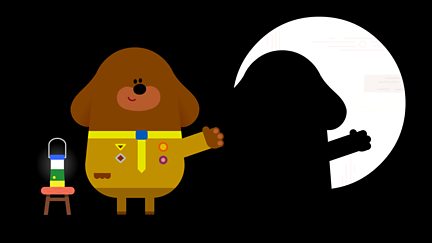
Sex: Nothing to get your pulse racing, although Duggee's shadow/silhouette could be considered somewhat disturbing... 2/10

Once Duggee stops waving, we all get very scared very quickly.


Music: A clear strong point. The mandolin and/ or ukulele theme is fun, and does not earworm in the irritating habit of Raa Raa or the Teletubbies. There's also some unexpected dalliances with what sounds like 1930s swing music during montages. Essentially, the producers have asked themselves the most important question in children's TV - not 'what would the children like?' - but 'what would I like?' 8/10

Plausibility: One of the most endearing elements of this (or any other) children's show is also one of the most subtle. As the animal parents transport the Squirrels to Duggee's and pick them up later, you might note that the crocodile (named Happy) is dropped off by an elephant, heavily implying that Happy is adopted. Nothing is made of this in the show, but I can't really call to mind any other feature in any other CBeebies broadcast which shows that kind of empathy. However, that is not to say that the channel does not champion other minority groups, as in Mr Tumble's output, and their employment of Cerrie Burnell. Obviously the rest of it is largely fantastical - sadly even the notion of a scout hut is perhaps a bit too much of a throwback to a bygone time for a lot of Young People Today™. 6/10

Education: Given the implausibilities mentioned above, it is not much of a surprise that the educational nature of the show falls largely under 'soft skills' rather than actual subject knowledge. To whit, friendship, teamwork, and co-operation are centre-stage in each episode, plus the comforting reminder that not every seemingly inappropriate children's supervisor has a sinister dark side. Duggee is very much to his Squirrels what Mr Poppy is to Nativity! On another level, if I was a child, and had a basic working knowledge of computers, I would be inspired to learn how Flash works, and seeing what I could do with it. However, I lack the knowledge, skills, inclination, creativity, and time in the day, so I will have to rely on straightforward blogging templates for the time being. 7/10.

Overall: Well played, everyone. 8/10

Thursday, 25 May 2017

Raa-Raa the Noisy Lion

Channel: CBeebies
Running Time: 10 mins
Date: 2011-

Raa Raa and the gang at their failed audition for the stop motion production of Bugsy Malone

Premise: Zoom in on a plasticine jungle - the 'jingly-jangly jungle' no less: a mixture of a Disney water park and the Swiss Family Robinson's legendary tropical crib. It looks like someone ran out of money for the jungle floor, which is plain white, a bit like when Neo gets some guns in the Matrix. Raa-Raa, the noisy lion, shares his jungle home with Topsy the Giraffe, Ooo Ooo the Monkey, Crocky the Crocodile, Zebby the Zebra, and Hufty the Elephant. You'll sense a theme emerging - that no-one on Raa-Raa's writing staff seems to be fully acquainted with which animals are typical jungle inhabitants.  But then maybe 'sexy, sunny savannah' didn't scan as well with the unbelievably catchy theme song.

Raa-Raa lives, seemingly without parental influence, or, it appears, any other lions, in a nicely furnished tree house, complete with a port for his 'cubby-buggy' - a little car whose fuel source is unclear (presumably not biofuels, given that this is one jungle yet to see the infraction of major logging companies). He tends to visit his friends throughout each episode, getting into minor scrapes and mishaps, and the kind of little misunderstandings that never quite threaten the inter-species harmony of the group. As the tale unfolds, a little singy-songy-chant emerges that fits the nature of the 'problem', eg: "Clangy-bangy singalong/ Crocky's got a bucket on!" (this example in trochaic tetrameter, for those of you who care about such things).

It appears that Raa-Raa is the 'leader' of the group, presumably because of his ability to roar the loudest. A specific characteristic has been applied to each secondary character: the giraffe is a bit of a bookworm, and has a collection on a rotating shelving unit that is theenvy of all metropolitan Guardian-reading remoaning parents such as myself. Hufty the elephant has a miniature train that somehow runs without rails, so probably doesn't qualify as a train. Zebby is fairly non-descript; her description in Wikipedia states that she 'sometimes gets hungry', which doesn't do enough in my eyes to truly differentiate her from every other living being on the planet. Ooo Ooo is by far the most cliched - a monkey who likes bananas and swinging on vines.

Crocky seems to be the one we should worry about the most: despite being a crocodile, he is seen fishing with a rod in the opening credits, rather than using millions of years of evolution to do this job himself. He also rides a log boat, which again calls into question whether or not anyone told him that he is a crocodile, and perfectly adapted to swim.

The end title sequence is fun, if only because it looks like each character is urinating behind a bush or tree.

Ban This Filth


Background: Stop-motion animation has come a long way since the iconic days of 1933's King Kong (another roary jungle dweller, by coincidence). My personal love affair with this medium is quite predictably Wallace and Gromit, but even since then there have seemingly been some radical advances. The process is still pretty slow - 11 seconds of footage per day - but each puppet now has a steel skeleton, takes 3-5 months to make, and costs around £4000 - £6000. Perhaps this is why Crocky doesn't swim - to protect that investment from getting rusty.

Lorraine Kelly provides the narration in a consistently 4th-wall-breaking interaction with Raa-Raa. Her maternal Glaswegian brogue is perfect for the show; unfortunately I can't escape remembering that, although she has seemingly avoided controversy for a while, she writes for The Sun, which has not exactly been my flavour of the month for the last 634 months.

Lorraine Kelly: Drafting another article for a truly appalling newspaper.

Entertainment:  Hard to gauge from my own little lion cub's point of view. He constantly demands "RAA RAA!" when there are other options, sits through the theme tune, then loses interest and wanders off to cause chaos elsewhere. I, on the other hand, am then left with the theme tune in my head for a number of days, and I just wanted to watch Naga Munchetty on BBC Breakfast.

From a parent's perspective, this is generally missable stuff. Its airtime of 6:50am means that if you have to watch it, you'll not necessarily have been up since the crack of dawn, which is where it holds an advantage over everything that comes before it.

Ratings:

Sex: No chance. It is almost as if the writers created a situation where sex was impossible: we have a feline, a pachyderm, an equid, a reptile, a primate and an ungulate. I believe that means breeding is impossible, and the Jingly Jangly Jungle is a one-generation experiment in extinction. 0/10

Music: Jesus. I have a grudging respect for this theme tune, as I'm quite keen on the jaunty keyboard riff. However, when you hear something before 7am and it's not something you'd willingly listen to at any other point in your life, somehow the earworm effect is doubled, and you end up with it stuck running round your skull for a disproportionate length of time. I can't get something cool, like Johnny Cash or Carole King resonating with me for more than an hour; I'm sure entire weeks have passed with nothing but the Raa-Raa theme in my head. Unfortunately, the aforementioned chanty-singy-songy stylings of Raa-Raa and co. bring this down a notch. 4/10

Plausibility: Neither lions, giraffes or zebras could be said to be jungle-dwellers, jingly-jangly or otherwise. Also, Topsy's library, although impressive, does not appear to take into consideration the humidity levels of one's average jungle, which means those books are going to be eaten up by mould and fungus by series 2. She needs to invest in a Kindle ASAP, and use that shelving system for something more sustainable.  1/10

Raa Raa also has the advantage of being the only character without a palm tree growing out of his head.
Overall: Meh. I don't find this as constantly irritating as Bing, but there is something a little soulless about Raa-Raa. There appears to have been too much focus-group, not enough heart. Sorry, Raa-Raa; I'm not sure I'd commission a third series, and I won't be mourning the day my little boy wants to watch actual lions with actual real-life lion problems, in a jungle-free context, on a David Attenborough documentary, or just down the road at Yorkshire Wildlife Park. As it stands, the theme tune is all he really wants.  4/10


Friday, 7 April 2017

Teletubbies

Teletubbies/ Teletubbies Redux
Channel: CBeebies
Running Time: 28 mins/ 15 mins

Simpler times, before cocaine addiction drove a wedge between Po and Dipsy.


Date: 1997-2001; 2015-present

Premise: A magical land, with a sky slightly too blue and grass slightly too green. Rabbits roam freely. The Teletubbies emerge from the top of a domed house covered in greenery - a very ecologically friendly design. They are Tinky Winky, Dispy, Laa-Laa and Po. Fat-bottomed, colourful, with an antennae on their heads and a television in their tummy, they are the delight of pre-schoolers and the disgust of many parents, dead homophobic American televangelists, and the Polish Ombudsman for Children; they are probably the most commercially successful children's TV characters in living memory.

In each episode, they do a lot of cuddling, eating Tubby Custard and Tubby Toast, talking in a simplistic and babyish style, and once an episode, a windmill transmits a TV signal to one lucky Tubby. The others gather round and watch a live-action video of some children doing some stuff (it changes each time: "some stuff" is the most specific I can be). The Tubbies want to see it again, and so they watch it again. Secondary characters include the Noo-Noo - a deliberately provocatively named anthropomorphic vacuum cleaner, and the 'Sun Baby' - a baby already old enough to have had a creepy 'all grown up' tabloid human-interest piece.

Added in the most recent revival series are the TiddlyTubbies: Eight - yes, eight - baby Teletubbies. This came as a massive surprise to those of us who assumed that the Teletubbies were already kind of babyish. Perhaps the aim was to mirror the relationship of younger siblings, perhaps they thought they could gouge out some extra cash from the commercial opportunities; regardless, it does leave twelve named Tubbies to keep up with. If you thought 'Laa-Laa' and 'Po' were a bit cringeworthy, save some moral outrage for Umby-Pumby, Mi-Mi, Daa Daa, Baa, Ping, Ru Ru, Nin, and Duggle Dee (I had to look this up because it sounds too close to 'Double D', which is clearly inappropriate, but it's in my head now, so that's what he'll have to be called).  Only one of the full-sized Teletubbies gets to play with the TiddlyTubbies at a time; I know I thought Flop was an inappropriate childminder for Bing on account of his size, but Ru Ru and co. don't even seem to have one appropriate adult present.
The Teletubbies have a horror movie spin-off planned for Halloween 2017; this is from the teaser trailer.
Background: This was the original hit for writer/creator Andrew Davenport, whose story of the creation of In The Night Garden is covered here. He was inspired, believe it or not, by the moon landings - and the way that the pinnacle of human achievement was visually presented thus: "like toddlers, with oversized heads and foreshortened legs – and they respond to the excitement of their new world by bouncing about."

He claims that he was also influenced by Benny Hill's fast forwarded sequences - which very much undersells the intellectual quality of Teletubbies' humour, and Morcambe and Wise - who I think he's being a little bit optimistic in mentioning. It's a bit like claiming the song 'Teletubbies Say Eh-Oh' was inspired by David Bowie.

The original series filmed in Warwickshire; the Teletubbies' house (the appallingly titled 'Tubbytronic Superdome') was the subject of intense media speculation in 1997, before Princess Diana died and took the heat off them for a bit. Davenport remembers: "We'd be trying to get on with making a quiet, innocent programme – with helicopters overhead and Land Rovers hurtling towards us", which to me just sounds like a cycle ride in central London.  

Tinky-Winky appears to have been the lightning rod for a number of controversies, all of which are perfectly understandable, if you are stark raving mad. Jerry Falwell, US televangelist, and fully paid-up member of the **** Club, described Tinky-Winky as a moral menace, on account of his purple colour (apparently the colour of gay pride), and his antenna being the shape of a triangle (apparently the gay pride symbol). Plus he carries what looks like a ladies' bag. Ken Viselman of Itsy-Bitsy Entertainment responded to the furore: "He's not gay. He's not straight. He's just a character in a children's series", which I found a disappointingly unprovocative response.
The most sexually provocative image in UK children's TV history, if you are a moron.
However, the Polish Ombudsman for Children was not satisfied. In 2007 she ordered her office's psychologists, who must have been delighted with the commission, to investigate. Her conclusion was delivered with the kind of gravitas you might expect from a report into gun-running or knife crime: "The opinion of a leading sexologist, who maintains that this series has no negative effects on a child's psychology, is perfectly credible. As a result I have decided that it is no longer necessary to seek the opinion of other psychologists." Presumably the next psychologist had to investigate communist subversion in Thomas the Tank Engine.  

Entertainment:  A tricky one. The runaway success with children, and its ability to inspire a smile, a dance, or just a general Pavlovian gratification upon a request ("DUBBIES!") and its fulfillment ("Yes, alright, just wait for f*cking iPlayer to work...") is priceless to any parent who dares to drink tea whilst it's hot (borrowed from the admirably realistic CBeebies mission statement).

Although the baby talk can grate, it is more the narrative style to which I object; though, being an English Literature graduate, you may accuse me of being unduly pedantic, or, in technical parlance, a "smart arse". The narrator tells a story in past tense: "One day, in Teletubby Land, the Teletubbies were playing hide and seek". The Teletubbies, however, are all stood in a line, and then react to the narrator, as if they were merely being directed by him, rather than acting on their own spontaneity. I would prefer the above narration to accompany a scene where the Teletubbies are already hidden, in order to maintain a sense of intrigue, basic viewer engagement, and just to give poor old Po a bit of dignity.

It's a net win, partially due to the 'again again!' quirk for the Tubby Tales, which wonderfully mirrors an infant's patterns of behaviour, and mentality, which must be a wonderful bonus for the producers, who get twice as much material for one outlay of a glorified family home video.

Ratings:

Sex: The Tinky Winky controversy is helping, as is the abundance of TiddlyTubbies, seemingly from nowhere. Are those rabbits symbolic? (6/10)

Music: More so than X-Factor, this Simon Cowell quote, regarding the race to sign the rights to 'Teletubbies Say Eh-Oh', tells you everything you need to know about him: "I heard another record label were about to sign the Teletubbies, so I got the BBC in my office and told them I would give them £500,000 in advance. We knew a record like that would make over £2 million." 
A heart-warmingly deserving beneficiary of the Teletubbies' success.

Total UK sales were 1.3 million, but it was beaten to the 1997 Christmas Number One spot by the Spice Girls' 'Too Much' (a title which was far too self-aware for its own good). 'Teletubbies Say Eh-Oh' was genuinely shortlisted for an Ivor Novello award, and is still the 83rd best selling single in UK history. Make of that what you will, but those are some impressive stats. (8/10)

Plausibility: Clearly it is absolute bonkers. The Teletubbies are bipeds, and rabbits do exist; that's all the Real you're getting. (2/10)

Education: Now, I'm pretty sure Teletubbies is helping my little boy, who is not even two years old yet, acquire vital life skills such as identification of colours, numbers, and what a Noo-Noo is. Whether or not that is impressive, I don't know or care; he is my son, ergo he is clearly a genius. But those who complain that it is not 'educational' are perhaps missing the point: not all children's TV should be educational, and for infants, education is an extremely problematic term. The Teletubbies hug each other a lot, and that is education enough for me. (5/10)

Overall: Ultimately one of the all-time classics, which irritates a lot of grown-ups for the following reasons: 1) it's not Bagpuss; 2) they didn't watch it when they were children so it's shit by default, 3) the baby talk, and 4) it has been ruthlessly exploited as a commercial vehicle, which they definitely wouldn't have done because they're morally superior. However, these people are humourless, and not currently trying to entertain a toddler. Long live the Teletubbies.  (9/10)