Showing posts with label review. Show all posts

Monday, 9 April 2018

Paw Patrol

Channel: Channel 5/ Nickelodeon

Running Time: 12 mins

Date: 2013 - present

Start with the toy, and work backwards to get a TV show


Premise: A ten-year old boy has somehow been put in charge of a municipal emergency services operation, and his employees work for dog biscuits (and a company vehicle). Every episode, a minor or major catastrophe (“no job’s too big, no pup’s too small!” as the theme tune has it) occurs, and the pups save the day. Eerily, this it is the kind of setup that you could imagine ham-faced coward (and former Prime Minister) David Cameron advocating as part of his ‘Big Society’ brainwave, where public services are underfunded to the extent that a primary school kid and some pre-pubescent canines have replaced the police, fire and ambulance service.  

The ten year old is Ryder, and his pups are Marshall, Rocky, Zuma, Chase, Rubble, and Skye (named after the island off the coast of Scotland, which is where you’ll want to run away to each time your little one asks to watch Paw Patrol). Each pup has a specialised vehicle and modus operandi, for example, Chase has the characteristics of a police dog, Marshall is a firedog and medic, and Skye is in charge of flying in a pink helicopter and giggling, because gender stereotypes. Rocky appears to have drawn the short straw - like the kid whose superpower was ‘heart’ in Captain Planet - and is in charge of ‘recycling’, which I’m all for, but maybe not as part of the emergency services. Then again, looking at the state of the oceans, perhaps it should be.

Each time there is a crisis, Ryder gets a video call on his phablet, summons the pups to headquarters, and outlines the situation to them, with the same kind of flat, monotonous tone that Britain has become used to with Theresa May’s takeover from Ham Man. Then the pups slide down into their individualised vehicles, which have been designed expertly to sell toys deal with various emergencies, and off they go. Imagine Thunderbirds, but designed for an era where two-year olds are routinely having decayed teeth removed under surgery, children can’t grip pens properly because their hands don’t have the strength to do anything other than tap touchscreens, and OH GOD JUST MAKE IT ALL STOP.

Background: In the past, TV shows such as Thunderbirds, or films like Toy Story made a huge amount of money from merchandising. And that’s OK, given that it rarely compromised the integrity of the stories themselves. Well, it’s time to give capitalism another big pat on the back, as Paw Patrol sees this concept work in reverse. The Canadian toy and entertainment company Spin Master had a prototype transforming toy that they wanted to make some more Canadian dollars out of, and other currencies as well, ideally. They approached the British producer Keith Chapman (Bob the Builder) and asked him to invent a franchise out of this toy. And thus, from one of Chapman’s concepts, Paw Patrol was developed by toy designers (do you spot the theme emerging?)
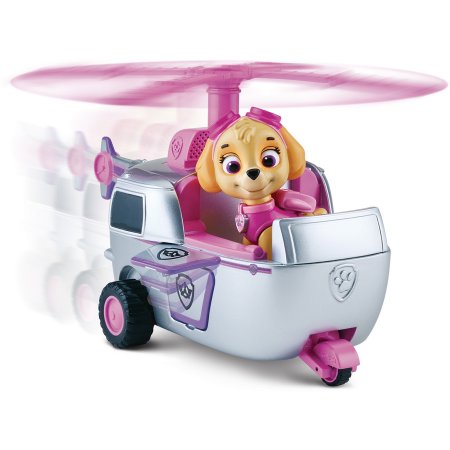
WHY IS SHE NOT WEARING A HELMET?


Nickelodeon announced it had picked up the franchise at the 2013 Licensing Expo in Las Vegas; the words ‘franchise’, ‘Las Vegas’ and ‘Nickelodeon’ being three of the worst things ever to be associated with children’s television, or humanity in general.

But wait! Here’s a line from a 2016 interview with Ben Gadbois, global president of Spin Master, which will curdle your very soul: “We’re continuing to invest in keeping the Paw Patrol content fresh, with new characters and themes in order to increase the longevity of the franchise.”

The tenth circle of hell that Dante didn't have time to include

It is hard to like Paw Patrol; it is harder to like it when you learn that essentially it is designed explicitly to sell toys as its primary function, rather than a happy sideline. Canada has given the world a lot of wonderful people - Mike Myers, Michael J. Fox, and Ellen Page among them - but Paw Patrol very much has to sit in the same row as Bryan Adams and Celine Dion.
Canada: Not as innocent as it seems


Entertainment: There is a huge amount to dislike, from the beginning title sequence to the end credit sequence, to the moment you realise you’ve had the theme tune in your head all week. The animation is sickly-smooth, but lacking any real heart; it resembles the graphics on a bad smartphone game, and leaves you contemplating the futility of existence in much the same way. Animation can thrive on its complexity (Wallace and Gromit) or its simplicity (Hey Duggee!) and Paw Patrol fits neither category.

The voice acting is dubbed for British audiences, and although it might be a cheap shot to have a go at child actors, it must be said that there is a woodenness to the delivery, extremely ironic given the amount of plastic that will be going into all those toys. The scripts mirror the animation in that they too sorely lack any heart - no one individual at any level really seems to ‘own’ Paw Patrol in the way that the Andersons did with Thunderbirds, so no-one cares that everything is geared towards shifting units at the expense of literally everything else.

In terms of plot lines, early episodes deal with stock animal rescue scenarios usually seen in Octonauts - saving a beached whale, saving some turtles, etc, quickly followed by the extraordinarily contrived - the pups fix a train line so a new version of a computer dance game will get through on time. Season Two sees the exact storyline pitched by the LA pigeons in Bolt - “aliens!” which should have pointed to the shark very much being jumped, and by season 4 we have occasional character Tracker dreaming that the rival mayor to Adventure Bay’s Mayor Goodway (keep up) has become a baby; I have not been able to clarify if David Lynch was guest director on that one.

The most worrying thing about this all is that children absolutely adore it. My own two-year old, otherwise a highly intelligent child, not only requests it with the kind of euphoric glee I reserve for a night in with a tub of hummus and a big bag of Kettle Chips, but requests the same three episodes over and over again. Today he hid in a box and said he was talking to Marshall. Somehow some Paw Patrol pants have worked their way into his chest of drawers. It’s like the film The Blob, only the Blob was supposedly a metaphor for communism, whilst Paw Patrol is being smacked over and over again in the face by rampant consumerism, if rampant consumerism came in the shape of a baseball bat with nails driven through. Which it does.

Paw Patrol is taking over your house; you'll wish you were as happy as that woman.

Ratings:

Sex: Although extensive breeding processes must have taken place in order to get to this stage, no obvious romantic sub-plots are evident. Ryder has a friend called Katie, who, as another ten year old, has been deemed qualified enough to run the local pet clinic, but it’s all very platonic and dull. None of the male dogs seems keen to take a run at Skye, which suggests that Katie maybe dealt with these pups a little while ago on a professional basis, and would account for all the unbroken voices.

Music: Upon listening to the theme, your initial reaction is, ‘my god, Sum 41 have fallen on hard times’. And upon googling Sum 41, you’ll see that they’re also Canadian (move up Bryan, Celine), and wonder whether there’s something in your initial thesis. But ultimately, no, the pop-punk sound has been taken, sanitised and turned into a powerfully catchy ditty by a group with the most obvious of names: Voodoo Highway Music & Post. The most irritating aspect is that you are led to believe that one of the dogs is called ‘Yeah!’ as the roll call elapses: “Marshall! Rubble! Chase! Rocky! Zuma! Skye! Yeah! They’re on their way…” Deal with the profound earworm by listening to Blink 182 again - the best example of a now-corrupted genre. (3/10)

Plausibility: Talking dogs who act as the emergency services, a ten-year old in charge, and a large urban area with no visible litter - you have come to the wrong place for verisimilitude. However, the fact that only one of the six pups is female does mirror current gender inequalities, so that’s very 2018. The most prominent female in a position of power, Mayor Goodway, is a ridiculous caricature of a ditzy, bumbling woman with a successful career in public service, much like the Daily Mail imagines Diane Abbott (or all women with jobs) to act - so is this plausible in terms of the representation of attitudes to women in politics, rather than the reality (which it obviously isn't)? I'll get my Sixth-Formers onto the case after the holidays. 

Popular representation of women in politics, 2018


Overall, the fact that the whole show is being played for the merchandising very much fits current trends of much of modern life being too painful to contemplate. (4/10)

Education: Tricky to place. Children won’t really learn much about the realities of the emergency services or local government, or how to ensure a gender balance in children’s TV, but in conversations with parents and caregivers they should be able to grasp concepts like ‘saturation point’ and ‘shareholder dividend’, so it’s swings and roundabouts really. (2/10)


Overall: What children’s TV would look like if Rupert Murdoch - a man so terrible, Dennis Potter named his cancer tumour after him - got his hands on it. Love and cherish the BBC, pay your licence fee, and don’t feel too bad about Toys ‘R’ Us closing down, because the toy companies are coming after your wallets, and your souls. (1/10)

Monday, 8 January 2018

Peppa Pig

Channel: Channel 5/ Nick Jr

Running Time:
5 mins (ish)

Date: 2004 - present
I have the most amazing pulled pork recipe, if anyone's interested. 

Premise:
***WARNING: THE FOLLOWING CONTAINS PUNS THAT HAVE NOT BEEN PASSED COMPLETELY SAFE FOR HUMAN CONSUMPTION***

Peppa is a young, animated, anthropomorphic pig who lives in a house with her mother and father, and her infant brother George. They live in a house at the top of an unrealistically steep hill, and have adventures of the sort that are kind of low-key in the same way as Bing, but without the downright-weird Flop element (If that sentence confuses you, head here).

Peppa and her family talk in English, but incorporate little snorts here and there to remind you that they’re actually pigs, unless you’d forgotten. They visit their grandparents, jump in puddles, ride bikes, go to the shops, pour-cups of tea, and generally live an idyllic piggy life (but if George goes missing, Peppa will do anything to get the baby back - and shoulder the blame herself). The sense of humour is pretty obvious; there are plenty of voice actors willing to ham it up. On the hoof, sometimes. You know, ad hock.

They are friends with other groups of animals, such as the rabbits, the dogs, the ponies, the zebras - the kinds of animals you see out and about everyday anyway. But what do you care? S’nowt to do with you. The original premise had most episodes set at their beach house near Copenhagen, but unfortunately they were duped by property scammers, and the incident was popularly known as the Danish Bay Con (I’ll stop now, but you’d have loved my reference to the numerous copies of A Doll’s House they have lying around the place. Oh, go on then. The spare-Ibsen).
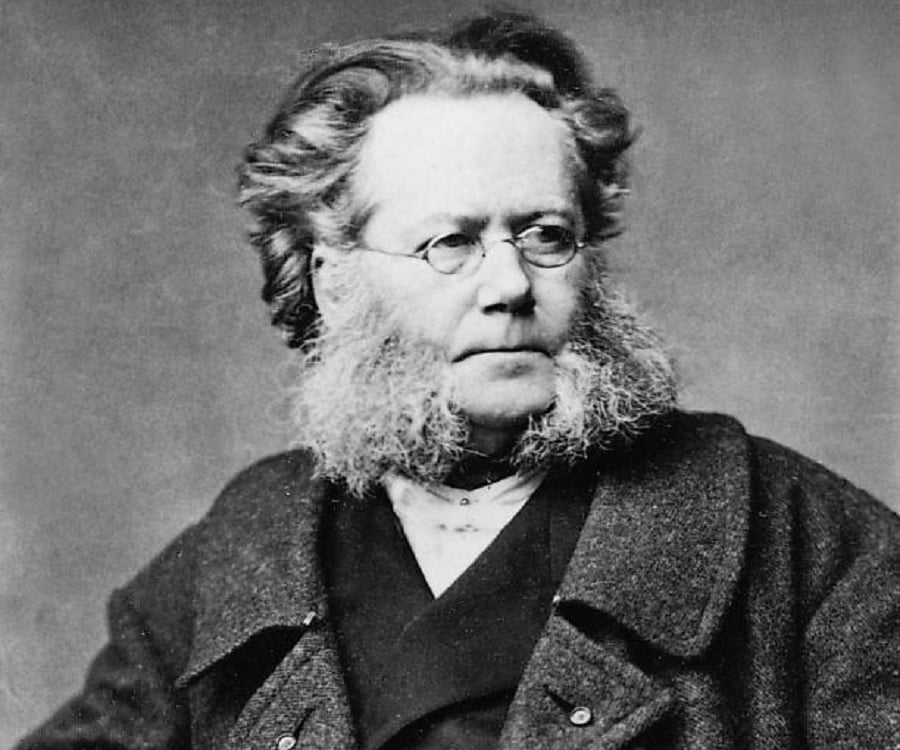
Henrik Ibsen: clearly a fan of chops. It is unclear how he felt about his name being used for third-rate puns. 

Peppa and her family appear live a life beyond free-range; despite this, their diet - especially Daddy Pig’s - is very unhealthy, and could invalidate any future claims that the future Peppacorn Sausages Range are organic.

Background: With their first foray into children’s television, The Big Knights, disappointingly treated by the BBC, the trio of friends Phil Davies, Mark Astley and Neville Astley said they would, in future, seek other outlets for their work. And this is why Peppa Pig isn’t a CBeebies programme, as it feels like it should be. Funded in part by Nick Jr and a lot by themselves, it appears that our three musketeers were very confident in themselves that they were on to a winner. Even though it seems ridiculous to look back on, back in the early part of the century a lot of children’s TV was dominated by male characters - Bob the Builder, Fireman Sam, Postman Pat. The idea of a female lead was a bit of a novel one. Our trio also knew that the way to big money was through the spin-offs and the merch - not the show itself. However, this extremely thorough and very interesting article from the FT in 2010, cite the 3 millionth DVD sale in that year - “at £10 a DVD, that’s quite a lot”, says Phil Davies, freshly returned from three months in the Maldives at that point, where clearly he had spent time brushing up on his maths. Although I’m personally not a massive fan of ostentatious wealth (unless it’s mine), these three gents seem to have taken an enormous risk with their own money, succeeded massively, and managed not to do it by selling arms or vlogging, and that is worth a lot of respect.
Co-creator Phil Davies describes himself as owning "a fancy car". See if you can guess how he affords it. 
For a seemingly innocuous programme, Peppa Pig really has caused a lot of controversy over the years. Peppa was a promotional figure for the Sure Start programme launched by the 1997-2010 Labour government, and confirmed that she would not be attending the launch of the party’s 2010 families manifesto ‘in the interests of avoiding any controversy or misunderstanding’, just in case anyone was more likely to vote for (or against) Labour on the basis that a fictional pig was in a photo op.

There were complaints, and subsequent retrospective animation, to include seat belts to the characters whilst in transit, which had been missed off as an oversight on the first couple of series, as were bicycle helmets. And, in 2012, the episode ‘Mr Skinnylegs’ was banned from broadcast in Australia after complaints were received about the sentiment that ‘spiders were not to be feared’.
(Hopefully) not an Australian spider. 
The most bizzare of these sideshows, and most open to deliberate misinterpretation by The Daily Mail click-bait hacks occured when Norman Lamb, Liberal Democrat leadership hopeful (four words which are increasingly funny when seen together in the same sentence), stated that children’s TV should include homosexual characters, as it was representative of modern society, and to exclude gay characters from children’s TV would suggest there is a limit to gay rights. When asked if there should be gay characters on Peppa Pig, he said it should not be “out of bounds… which it appears to be at the moment”. Of course, this was twisted deliberately by the tabloids, not least in the Mail headline “It’s time for a LESBIAN Peppa Pig”, which is not at all what Lamb was saying, but hey, clicks.

Entertainment:
A strong one from both parent and child perspectives. The voice acting - particularly from Daddy Pig (Richard Ridings) and the narrator (John Sparkes) stand out as charming and earnest, and the children are not bad either. The stories never achieve the levels of tweeness and saccharine that Bing and Topsy and Tim aspire to - there is a sense of fun embedded in each episode, and ‘learning’ is thankfully given a back seat (in a seat belt, one hopes) to the silliness, tomfoolery, and downright nincompoopery of the script. The episodes are nice and bitesize for our toddler, and one blends into the other quite seamlessly for a good Amazon Prime bingewatch.

Ratings:

Sex:
Given that a typical litter of (domesticated) pigs ranges from 5-25 piglets (averaging 10-12), it appears that Mummy and Daddy Pig either ate all the other pigs in each litter that produced Peppa and George, or Daddy Pig’s much commented-upon obesity has affected his fertility, his sex drive, or both. (1/10)
Music: The theme tune is catchy without being too intrusive; there is a nice, brassy, oompah-oompah feel to it, which is tonally consistent with the rest of the show. Although I’ve heard numerous complaints about earworm, this is much less annoying than Raa-Raa. (7/10)

Plausibility: Many obstacles here, the pig thing being the most obvious. Although the steepness of the hill upon which Peppa’s house is built is an obvious starting point for pedants, it should be noted that a) Daddy Pig works as a architectural engineer and should know his stuff, b) the structural integrity of the house has (as of writing) yet to be featured in the plot, and c) the writers wanted it that way, to match the way in which children draw their own houses. And, more importantly, Mark Baker notes: “Well, it’s just that having a huge hill like that is so funny. And ridiculous – that every time Peppa and George run out to play, they have to run down this very, very steep hill. It is optimistic, and fun.” An optimistically steep hill. There you go. (5/10)

House/ pigs not drawn to scale. 
Education: Some important messages about family unity and inter-sibling co-operation are established early, and maintained throughout. Children are certainly not being stretched in terms of how different kinds of families are presented - this setup is strictly nuclear and traditional. Whilst this is fine on its own terms, it will be interesting to see when children’s - especially pre-schoolers’ - television presents a non-traditional family unit and doesn’t make a big deal about it.

Daddy Pig is perhaps the true hero of the show in that he never lets embarrassment or failure get in the way of his cheery demeanour, which is a good lesson for adults, if not the target audience. (8/10)

Overall: A triumph of pre-school schedules - this is not quite in the same vein as the all-time classics of Teletubbies, In The Night Garden and Thomas the Tank Engine, but I reckon if you ask a five year old they’d likely disagree. Peppa isn’t going anywhere soon, unless there is a nuclear holocaust, in which case her isolated, unsheltered hill-top dwelling is likely to be among the first casualties of the blast. I found Peppa the more charming the more I wrote about her, and even though I’d eat a chorizo sausage made out of her, I’d feel slightly sad about it.
Well worth including as part of a diverse televisual portfolio. (8/10).

Catch up on any missed blogs here, including The Furchester Hotel, Bing, In the Night Garden, Teletubbies, and Postman Pat SDS.

Monday, 24 July 2017

Hey Duggee!

Channel: CBeebies

Running Time: 7 minutes

Date: 2014- present

Early spoiler: this show is much, much better than it looks...


Premise: A series of anthropomorphic animal characters regularly attend a kind of after-school/day care style club: The Squirrel Club (though it appears that few, if any actual squirrels attend). Said club is run by the eponymous hero, Duggee, a large cuddly dog who only ever says 'Woof!', but has obtained the requisite paperwork to look after a number of young children in a variety of indoor and outdoor settings. Imagine Hodor as a Cub Scout Leader, and you're about there.

The Clubhouse: building and owner presumably up-to-date with all current Ofsted requirements

Each episode, the Squirrels earn a badge of some kind, related to the activity or challenge or problem that has been thrown their way in that episode. Some are more mainstream (the Drawing Badge, the Rescue Badge and the We Love Animals Badge), some are quite niche (the Omelette Badge, the Dancing Bug Badge) and some are just so 21st century (the Yoga Badge). Yet to be confirmed for series three are the Brexit-Means-Brexit Badge, the Safe-Sexting Badge, the Fidget-Spinner Badge, and the badge for big fans of 1990s episodes of Neighbours (the Madge Badge).

Some of the badges available to the Squirrels; also a range of attractive yet affordable coasters.


A cast of regular and minor characters keep things fresh and bouncy, such as the hippy Rabbits, and my personal favourites, the gangster mice (catchphrase upon departing a scene "Let's Bounce!", popularised in an early draft of Romeo and Juliet; Shakespeare eventually went with "Hence, be gone, away!")

The animation is minimalist but colourful; the plots are imaginative without slipping into 'zany', or zany's idiot cousin, 'wacky'; and the voice talent ranges from the subtle youngsters (learn a lesson, Bing), to the instantly recognisable (Alexander Armstrong, currently running out of digits to place into so many pies).

Background: Creator Grant Orchard of Studio AKA explains a lot in this comprehensive interview. He has a background in Flash animation and advertising, and clearly has affection for the aesthetic and the tone of the show. He is also one of the few people who goes out of their way to put a lot of their success  down to luck, which gives him bonus points.
He was asked to pitch an idea, he came up with some of the characters, and the rest, as they say, was developed over a consequent series of brainstorming sessions, animation tests, focus groups and pilot episodes. Or something.

The animation is all done on something called Flash, which I only know from the amount of times it crashes my browser, but I'm glad there are genuinely people out there who know what it does and how it is used. For simplicity's sake, Duggee is the only character with shade gradients, and some characters are simple shapes (the frogs are just green triangles with eyes, and it's about time someone took them down a peg or two).

A tutorial on how to draw a triangle with eyes. Somehow, three previous steps are necessary to get to this point.


It has recently won an International Emmy Kids Award for best Pre-School show. At the same awards, a Danish show called Ultras Sorte Kageshow won for 'Best Non-Scripted Entertainment', which sounds a bit creepy, until you find out the translation is 'Baking in the Dark', and then it sounds completely creepy, like being stalked by Paul Hollywood.

Entertainment: Hey Duggee! is difficult not to love. The pace and tone are warm, energetic and playful, and there is a lot of self-awareness that is lacking in, say, let's pick on Bing again. Most funny is the fact that I watch the show in Yorkshire, a county where a 'Duggee' is a derogatory term for someone who has found themselves, by no fault or complete fault of their own, in the lowest set in a subject at school. It is like calling a show 'Hey Pleb!' or 'Hey Jeeves!' if you went to Eton.

At a first glance the Flash animation looks as if it's quite lazy - the demands of pre-school TV ensure plenty of content at the lowest cost. However, the animation style is probably one of its greatest strengths - the minimalism that works so well with web comics like XKCD helps you focus on the difficult plot points. There is a lovely surrealism to Hey Duggee! - not the dreamy hippy schtick of In the NightGarden, but perhaps something more in the way of magic realism crossed with a folk song.

Characters so simple, even a highly trained professional animator could design them.


Ratings:

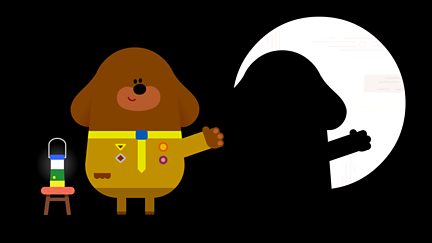
Sex: Nothing to get your pulse racing, although Duggee's shadow/silhouette could be considered somewhat disturbing... 2/10

Once Duggee stops waving, we all get very scared very quickly.


Music: A clear strong point. The mandolin and/ or ukulele theme is fun, and does not earworm in the irritating habit of Raa Raa or the Teletubbies. There's also some unexpected dalliances with what sounds like 1930s swing music during montages. Essentially, the producers have asked themselves the most important question in children's TV - not 'what would the children like?' - but 'what would I like?' 8/10

Plausibility: One of the most endearing elements of this (or any other) children's show is also one of the most subtle. As the animal parents transport the Squirrels to Duggee's and pick them up later, you might note that the crocodile (named Happy) is dropped off by an elephant, heavily implying that Happy is adopted. Nothing is made of this in the show, but I can't really call to mind any other feature in any other CBeebies broadcast which shows that kind of empathy. However, that is not to say that the channel does not champion other minority groups, as in Mr Tumble's output, and their employment of Cerrie Burnell. Obviously the rest of it is largely fantastical - sadly even the notion of a scout hut is perhaps a bit too much of a throwback to a bygone time for a lot of Young People Today™. 6/10

Education: Given the implausibilities mentioned above, it is not much of a surprise that the educational nature of the show falls largely under 'soft skills' rather than actual subject knowledge. To whit, friendship, teamwork, and co-operation are centre-stage in each episode, plus the comforting reminder that not every seemingly inappropriate children's supervisor has a sinister dark side. Duggee is very much to his Squirrels what Mr Poppy is to Nativity! On another level, if I was a child, and had a basic working knowledge of computers, I would be inspired to learn how Flash works, and seeing what I could do with it. However, I lack the knowledge, skills, inclination, creativity, and time in the day, so I will have to rely on straightforward blogging templates for the time being. 7/10.

Overall: Well played, everyone. 8/10

Friday, 10 February 2017

In the Night Garden

Channel: CBeebies

Running Time:  30 minutes, somehow

Date: 2007- present

Not a metaphor for death.


Premise: God knows. We begin with a night sky, a different child each episode being lulled to sleep by his/her parent's finger circling their hand, and Derek Jacobi narrating the tale of a 'little boat, no bigger than your hand,/ Out on the ocean far away from land'. Then a cut to IgglePiggle in his small wooden boat, taking down his sail/blanket, and drifting off to sleep. The night sky's stars become flowers, which bloom, and reveal IgglePiggle meeting his friends in the Night Garden, which looks like a National Trust park viewed through the eyes of what people who haven't taken LSD imagine a trip consists of.

The Night Garden is a kind of enchanted forest, where IgglePiggle's friends all live. There is the hyperactive, dancing Upsy Daisy; the miniature Trumpton/Chigwell-esque Pontipines (8 children no less); the often-trouserless Tombliboo triplets; the pointless, slow, enormous beachbally Haa-Hoos; and my personal favourite: Makka-Pakka, a tubby little creature with a little bit of OCD for collecting stones and washing things. They ride on the Ninky-Nonk (a kind of train) and the Pinky-Ponk (a zeppelin), which are often involved in non-fatal crashes. At the episode's conclusion, all the protagonists go to sleep, except IgglePiggle, who we see asleep in his boat, in a satisfying frame narrative.

Whether IgglePiggle has died and is crossing Hades into the afterlife, reuniting with his friends from life; whether it is a surrealist orgy of sex and death;  or simply a nice bit of imagery for the under-3s, with no duplicitous meaning whatsoever, is unclear. Are we in the dream of the child or the dream of IgglePiggle? Is the cut from the child to Igglepiggle a suggestion that the silent blue biped, who squeaks, jingles his bell, and carries his red comfort blanket, is our spirit animal of childhood? Is there a little bit of IgglePiggle in all of us? (stop giggling at the back).
Whatever the answer, it's a smash: a proper classic piece of children's TV. Nice one CBeebies.  

Background:
If you think there are few little similarities with Teletubbies, that's because Andrew Davenport is the creator of both; In the Night Garden, the later project, was born in 2007. Upsy Daisy (Rebecca Hyland) has also been Laa-Laa since 2015, and Dipsy and IgglePiggle are both 'interpreted' by the same person, the wonderfully named Nick Chee Ping Kellington.

Davenport's long-time collaborator Anne Wood had this to say about their rationale behind the show : " We wanted to explore the difference between being asleep and being awake from a child's point of view: the difference between closing your eyes and pretending to be asleep and closing your eyes and sleeping".  Where the Haa-Hoos come into this is anyone's guess.

The Haahoos: Deflate, and do not resuscitate.

The show has gone from strength to strength; a live show, to be witnessed by Mr Blog, Mrs Blog and Toddle Blog in July, has toured the UK every year since 2010, and the merch makes, shall we say, 'great commerical sense', and gives you money back from your licence fee. And a lot of money for a lot of your licence fee: the BBC ploughed nearly £15m into the show's 100 episodes. One engineer told the Observer's Harriet Lane that they once spent 100 hours editing a sequence that lasted 16 seconds. Apparently one of the most difficult technical challenges is sending the Tombliboos' trousers all around the Garden. ('What did you do at work today, dear? What, still?')

As with the Teletubbies, Night Garden provokes some very polarised opinions, but mostly on the part of the parents. Children, mine included, just love it. Andrew Davenport has a lovely anecdote about how he loved to go to bed at his grandma's house, as he associated the normal bedtime routine at home with grouchiness, and tantrums, whereas his grandma's house represented peace, love and wonder. He aimed to replicate this in the Night Garden: "  It seemed the right thing to do, to make a calming programme that would capture the atmosphere that I remembered, that sense of peace and security, warmth, the moments of silliness that you share with whoever's reading you the story." Arise, Sir Davenport.

Entertainment:
You can probably tell by now that I'm a big fan. I could explore the finer technical, narrative and symbolic nuances, but I'm sure they'd be lost on you. The show is a success largely because of its mixture of comfort and chaos: you always know there will be a Ninky-Nonk and/or a Pinky-Ponk, you know there will always be a still animation plenary, you know every character will introduce themselves with a song and dance that never changes. But when the Ninky-Nonk has had enough of horizontal travel, it will drive up the trunks of the trees, and twist around the branches - essentially, exactly how I just-about-remember brumming my toy cars up the sides of the sofa and on the underside of my desk. When the Tombliboos feel the need, their trousers just fly off, in scenes which are clearly a subtle homage to the anarchy of the Carry On films. When the Ball (just a random ball) gets tired, Upsy Daisy will put it to sleep in her bed. A bed which is on wheels, by the way - it's a bit like Herbie, but easier to sleep in than a Beetle.

Carry On Tomblibooing

There is something soothing about the repetitive patterns - the tropical birds (the Tittifers - yes, I know...) who serve as musical interludes to the action, and signal the beginning of the wind-down;  the bedtime routines of each character; IgglePiggle's inability to get to bed on time each evening; the zoom out from the garden, where the lights merge seamlessly into the constellations of the night sky over IgglePiggle's boat; and the beautiful, beautiful music, which makes it a slight shame there isn't a repeat for parents at around 9:45, just in time for our upstairsy time. Ultimately I am more entertained by my boy watching this than I am by the show, but that's as it should be.

Ratings:

Sex: Surprisingly high. The Tombliboos are obviously trouserless for large sections of the show; Upsy Daisy and IgglePiggle clearly have some chemistry, and are keen to exchange lip-kisses regularly. IgglePiggle sometimes ends up in Upsy Daisy's bed, no less, but in defence of her reputation, she is never in there at the same time, and she is never less than vexed when she finds out. Also, the Pontipines and Wottinger parents have had 16 kids between them. There's something in that Pinky-Ponk juice. 8/10

IgglePiggle takes a special interest in Upsy Daisy's bed. Again.

Music: The opening and closing themes are perfectly judged - none of the bombastic pomp of Teletubbies, broadway inspired 'Furchester Hotel' or ostentatious disco of Go-Jetters, but well-judged for the bedtime hour. The characters' personal songs are idiosyncratic enough to not get hugely irritating, and the gazebo dance (in many, but not all, episodes) is a nice lesson in crescendo, in the way Michael Jackson's 'Don't Stop Til You Get Enough' and Daft Punk's 'Da Funk' are. My current favourite is the Tombliboo teeth-brushing song, which has some excellent drum and piano work, which Scott Joplin fans will appreciate. The fact that the Tombliboos don't actually have teeth is irrelevant.  9/10

Plausibility: This is either the most realistic interpretation of a dream, or childhood imagination, that could exist, or a fantasy land where children are encouraged to believe in personified beach balls and stone-hugging troglodytes. The Ninky-Nonk and Pinky-Ponk are inconsistently sized, Social Services never seem to get involved when the Pontipine children keep going missing, and the idea that Makka-Pakka is comfortable sleeping on that rock is frankly ludicrous. However, there are no wild claims of verisimilitude from the programme makers, and it should be viewed through this prism. The fact that you would quite like the world to be more like the Night Garden is enough reason to invest as much belief in its existence as you can.  1/10 or 10/10, delete according to preference/ amount of soul you possess.

Don't tell the Daily Mail.

Education: My favourite thing about Seinfeld is not the writing team's mantra: 'No hugging, no learning'. My favourite thing about Seinfeld is obviously Elaine. But that mantra is a close second; it's why it has aged so much better than Friends. In the Night Garden does have hugging - IgglePiggle and Upsy Daisy can't help themselves - but the almost deliberate attempt to avoid a moral 'lesson' is comforting in this world of 'Bing' and the sanctimonious Octonauts. The closest we get to moral judgement is Jacobi's 'Isn't that a pip?!' exclamatory question, when things have just gone a little bit crazy. It means nothing, and that is particularly welcome at the end of a long day with a toddler. 2/10


Overall:  You can sense where I'm heading with this. In the Night Garden is in the league of children's TV royalty alongside Thomas the Tank Engine, the Clangers, Bagpuss, Dangermouse, Teletubbies, Blue Peter, and Sooty; I'm sorry to those I've left out who are obvious additions to that hall of fame. The sad thing is that it might not even be remembered by those who appreciate it the most: for the under 3s, they will perhaps grow out of it before their long-term memory is developed, but they owe more to it than they ever realise. As a parent, I can only stand back and applaud something that brings such uncomplicated joy to my Little.  9.5/10

Tuesday, 7 February 2017

Postman Pat SDS

Channel: CBeebies

Running Time: 15 minutes

Date: 2008- present

The original Postman Pat and Jess, back in the 1980s when you were a child, and nothing bad ever happened.

 Premise: Postman Pat has somehow been promoted, which would be outrageous, but when this spin-off first aired in 2008, Barack Obama was about to become president, and there was the sense that generally people got the jobs they were qualified for. Two years later, David Cameron became Prime Minister, and Postman Pat's rapid succession perhaps serves as a foreshadowing of the horrors of promoting incompetent ham-faced charlatans beyond their ability level.

Each episode, Pat is seemingly allowed to abandon his daily rounds, and scoot off to the nearby town of Pancaster to collect a 'Special Delivery', at the beck and call of the enigmatic 'Ben', possibly named after Ben Fogle, whom he resembles. Despite strict privacy laws, Ben and Pat are apparently allowed to open, examine, and sometimes play with the items that Pat is supposed to deliver.

Ben: Keeps breaking privacy laws.

Because children are supposedly too immature to appreciate the finer points of professional, efficient postal delivery, Pat is allowed to spend an entire day delivering one item, in one of his five  vehicles: aeroplane, helicopter, motorbike/sidecar, 4x4 jeep, and his regular van. He's really taking the 'Green' out of 'Greendale'. This is why they had to hike the price of stamps a couple of years ago.

Chuck in your regular supporting cast, who are really pushing the accents past 'unlikely' to 'really quite offensively poor', and some children who speak exclusively nasally, and you have Postman Pat SDS. 

Background: You all loved Postman Pat when you were children. Some of you, such as my friend Nick, had the soundtrack on vinyl, which was then added to the collection alongside Armand Van Helden and Paul Van Dyk in the late 90s, alongside a heavy dose of millennial irony. But in the same way that Hollywood is now only sequels and superheroes, someone at the BBC decided that the old episodes weren't enough for the new generation of pre-schoolers, who famously demand more 'pizzazz' from their postal distribution-based stop-motion animation. To avoid looking out of touch in a world where most of your post comes from Amazon, packaged by zero-hours minimum wage slaves, and is delivered in the middle of the day when everyone is at work, this spin-off was commissioned.

Postman Pat updated for the 21st century: on course to be history's most appalling century.

You're all wracking your brains trying to remember the episode where Postman Pat was mistaken for a member of the Japanese organised crime group the Yakuza, aren't you? Well, in 1994 Postman Pat was given an extra finger to bring him up to 5 digits, in a bid to avoid scaring Japanese children. The members of the Yakuza apparently cut off one finger in order to show their dedication and trustworthiness, and it was genuinely believed that Japanese children would mistake Postman Pat for a gangster. Just re-read that sentence again, and let it sink in. Bob the Builder went through the same process in the year 2000. We have lived through a digital revolution in more ways than one.

Entertainment: It has an unmistakable feel of the 'focus group' about it. You can visualise some suit at the BBC, presumably the person who also ruined Thomas the Tank Engine, walking round a meeting room asking the writers to make Pat 'more relevant'. Hence the rural idyll of Greendale has to share the Pat Map with the much more cosmopolitan 'Pancaster' , where presumably the aforementioned 'Ben' has a 'luxury flat', goes to wine bars, and buys his frappucinos from Cafe Nero. The set up - Pat is supposed to deliver post, makes a bollix of it - is much the same as in the original Postman Pat episodes from the 1980s, but with a bit more of a nod towards technology. For instance, we get a Loch Ness Monster Locator, delivered to Scotland in the middle of the day, by plane, to Mrs Goggins, who clearly cannot afford the delivery costs on her salary.

Celebrity culture has also hit, with popstar 'Brad Lee' making an appearance in season three: a bad boy with all the danger of a plasticine Jonas Brother; perhaps as a nod to the success of Downton Abbey we also see a cameo from the Duchess of Pencaster. Although I haven't seen it yet, there is an episode featuring a character called 'Sean McGuiness'. I get the feeling I know where he's going to be from. It is quite easy to picture the voice cast all putting up their hands to tell teacher what accent they can do - or, by the sounds of some of them, which ones they'll have a go at.

I can't remember the children of Greendale having so much airtime in the 1980s episodes, which might be a trick of the memory, but perhaps one based in my hatred of these whinging little gits. They all speak through their nose, and they appear to have got their pathetic inability to respond to setbacks from Bing the Bunny.

No-one ever watched Postman Pat for the children. No one watched it wishing Pat had a 4x4. No one wanted to see D-grade celebrities in Greendale.

It was supposed to be all about the post.

Ratings:
Sex: Not a sniff. Despite the opportunities for a postal delivery worker to witness things he really shouldn't (see the Speed 3 episode of Father Ted), 'Confessions of a Stop-Motion Postal Operative' it ain't. This is very much safe for work. And your pre-school child. 1/10

Music: They have retained the spirit of the original theme song, with a couple of nods to the 21st century with some slightly slicker synthesisers, and a disconcerting replacement of the 'letters' from 'letters to your door' with 'parcels', which always puts me off my stride. Some stupid nonsense pop songs about inclusion and fun have replaced classic declarative statement songs like 'Jess is His Cat'. Like almost everything from your childhood, apart from Margaret Thatcher, it was better in the 1980s. 4/10

Plausibility: Depends on your outlook. If you believe that the public sector is a bloated, inefficient, uncompetitive, stagnant waste of space, then you will be gullible enough to believe that the amount of tax pounds (always sounds worse than dollars, and they're nearly worth as much now) required to keep Pat's fleet of unnecessary vehicles running is a realistic portrayal of public sector waste. You never engage with public services anyway because you are too rich to care. Your name might be Alan Duncan, Jacob Rees-Mogg, Peter Bone or Philip Davies, and you can do one.

The price of 1st class stamps increased 100% from 2006 to 2016. Guess why.


However, if you actually work in or have dealt with the public sector in any way, then you will see Pat's luxury is the product of lazy writing, and the commercial department rubbing their thighs at the chance to release some new toys. However, the increased effort to make Greendale a bit more racially diverse is welcome, and probably annoys those aforementioned Tory arses, so that rescues some marks. 5/10

Education: Not a huge amount on offer, which is annoying, given its classic status in children's TV. Even the school scenes are short on content, largely to do with the fact that everything they need for their lessons is only being delivered that day by Pat. A bit of a return to silent writing and reading would be a refreshing step in Greendale Comprehensive (though it's probably Greendale Academy: A Performing Arts College by now). Doesn't teach you much about life, or the post. 2/10

Overall: There is an episode of The Simpsons where they attempt to revive Itchy and Scratchy through focus groups and network executives, and come up with Poochie the Dog, which fails, for those exact reasons. Ivor Wood, the original creator, died in 2004, and I like to think he would have said 'bugger off' to anyone who said they could improve Pat. Either that, or he's a dead-eyed capitalist who specifically requested in his will that this particular cow be cashed, without checking the quality of the milk first. 5/10