Monday, 24 July 2017

Hey Duggee!

Channel: CBeebies

Running Time: 7 minutes

Date: 2014- present

Early spoiler: this show is much, much better than it looks...


Premise: A series of anthropomorphic animal characters regularly attend a kind of after-school/day care style club: The Squirrel Club (though it appears that few, if any actual squirrels attend). Said club is run by the eponymous hero, Duggee, a large cuddly dog who only ever says 'Woof!', but has obtained the requisite paperwork to look after a number of young children in a variety of indoor and outdoor settings. Imagine Hodor as a Cub Scout Leader, and you're about there.

The Clubhouse: building and owner presumably up-to-date with all current Ofsted requirements

Each episode, the Squirrels earn a badge of some kind, related to the activity or challenge or problem that has been thrown their way in that episode. Some are more mainstream (the Drawing Badge, the Rescue Badge and the We Love Animals Badge), some are quite niche (the Omelette Badge, the Dancing Bug Badge) and some are just so 21st century (the Yoga Badge). Yet to be confirmed for series three are the Brexit-Means-Brexit Badge, the Safe-Sexting Badge, the Fidget-Spinner Badge, and the badge for big fans of 1990s episodes of Neighbours (the Madge Badge).

Some of the badges available to the Squirrels; also a range of attractive yet affordable coasters.


A cast of regular and minor characters keep things fresh and bouncy, such as the hippy Rabbits, and my personal favourites, the gangster mice (catchphrase upon departing a scene "Let's Bounce!", popularised in an early draft of Romeo and Juliet; Shakespeare eventually went with "Hence, be gone, away!")

The animation is minimalist but colourful; the plots are imaginative without slipping into 'zany', or zany's idiot cousin, 'wacky'; and the voice talent ranges from the subtle youngsters (learn a lesson, Bing), to the instantly recognisable (Alexander Armstrong, currently running out of digits to place into so many pies).

Background: Creator Grant Orchard of Studio AKA explains a lot in this comprehensive interview. He has a background in Flash animation and advertising, and clearly has affection for the aesthetic and the tone of the show. He is also one of the few people who goes out of their way to put a lot of their success  down to luck, which gives him bonus points.
He was asked to pitch an idea, he came up with some of the characters, and the rest, as they say, was developed over a consequent series of brainstorming sessions, animation tests, focus groups and pilot episodes. Or something.

The animation is all done on something called Flash, which I only know from the amount of times it crashes my browser, but I'm glad there are genuinely people out there who know what it does and how it is used. For simplicity's sake, Duggee is the only character with shade gradients, and some characters are simple shapes (the frogs are just green triangles with eyes, and it's about time someone took them down a peg or two).

A tutorial on how to draw a triangle with eyes. Somehow, three previous steps are necessary to get to this point.


It has recently won an International Emmy Kids Award for best Pre-School show. At the same awards, a Danish show called Ultras Sorte Kageshow won for 'Best Non-Scripted Entertainment', which sounds a bit creepy, until you find out the translation is 'Baking in the Dark', and then it sounds completely creepy, like being stalked by Paul Hollywood.

Entertainment: Hey Duggee! is difficult not to love. The pace and tone are warm, energetic and playful, and there is a lot of self-awareness that is lacking in, say, let's pick on Bing again. Most funny is the fact that I watch the show in Yorkshire, a county where a 'Duggee' is a derogatory term for someone who has found themselves, by no fault or complete fault of their own, in the lowest set in a subject at school. It is like calling a show 'Hey Pleb!' or 'Hey Jeeves!' if you went to Eton.

At a first glance the Flash animation looks as if it's quite lazy - the demands of pre-school TV ensure plenty of content at the lowest cost. However, the animation style is probably one of its greatest strengths - the minimalism that works so well with web comics like XKCD helps you focus on the difficult plot points. There is a lovely surrealism to Hey Duggee! - not the dreamy hippy schtick of In the NightGarden, but perhaps something more in the way of magic realism crossed with a folk song.

Characters so simple, even a highly trained professional animator could design them.


Ratings:

Sex: Nothing to get your pulse racing, although Duggee's shadow/silhouette could be considered somewhat disturbing... 2/10
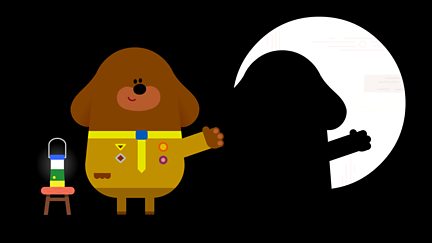
Once Duggee stops waving, we all get very scared very quickly.


Music: A clear strong point. The mandolin and/ or ukulele theme is fun, and does not earworm in the irritating habit of Raa Raa or the Teletubbies. There's also some unexpected dalliances with what sounds like 1930s swing music during montages. Essentially, the producers have asked themselves the most important question in children's TV - not 'what would the children like?' - but 'what would I like?' 8/10

Plausibility: One of the most endearing elements of this (or any other) children's show is also one of the most subtle. As the animal parents transport the Squirrels to Duggee's and pick them up later, you might note that the crocodile (named Happy) is dropped off by an elephant, heavily implying that Happy is adopted. Nothing is made of this in the show, but I can't really call to mind any other feature in any other CBeebies broadcast which shows that kind of empathy. However, that is not to say that the channel does not champion other minority groups, as in Mr Tumble's output, and their employment of Cerrie Burnell. Obviously the rest of it is largely fantastical - sadly even the notion of a scout hut is perhaps a bit too much of a throwback to a bygone time for a lot of Young People Today™. 6/10

Education: Given the implausibilities mentioned above, it is not much of a surprise that the educational nature of the show falls largely under 'soft skills' rather than actual subject knowledge. To whit, friendship, teamwork, and co-operation are centre-stage in each episode, plus the comforting reminder that not every seemingly inappropriate children's supervisor has a sinister dark side. Duggee is very much to his Squirrels what Mr Poppy is to Nativity! On another level, if I was a child, and had a basic working knowledge of computers, I would be inspired to learn how Flash works, and seeing what I could do with it. However, I lack the knowledge, skills, inclination, creativity, and time in the day, so I will have to rely on straightforward blogging templates for the time being. 7/10.

Overall: Well played, everyone. 8/10

Thursday, 25 May 2017

Raa-Raa the Noisy Lion

Channel: CBeebies
Running Time: 10 mins
Date: 2011-

Raa Raa and the gang at their failed audition for the stop motion production of Bugsy Malone

Premise: Zoom in on a plasticine jungle - the 'jingly-jangly jungle' no less: a mixture of a Disney water park and the Swiss Family Robinson's legendary tropical crib. It looks like someone ran out of money for the jungle floor, which is plain white, a bit like when Neo gets some guns in the Matrix. Raa-Raa, the noisy lion, shares his jungle home with Topsy the Giraffe, Ooo Ooo the Monkey, Crocky the Crocodile, Zebby the Zebra, and Hufty the Elephant. You'll sense a theme emerging - that no-one on Raa-Raa's writing staff seems to be fully acquainted with which animals are typical jungle inhabitants.  But then maybe 'sexy, sunny savannah' didn't scan as well with the unbelievably catchy theme song.

Raa-Raa lives, seemingly without parental influence, or, it appears, any other lions, in a nicely furnished tree house, complete with a port for his 'cubby-buggy' - a little car whose fuel source is unclear (presumably not biofuels, given that this is one jungle yet to see the infraction of major logging companies). He tends to visit his friends throughout each episode, getting into minor scrapes and mishaps, and the kind of little misunderstandings that never quite threaten the inter-species harmony of the group. As the tale unfolds, a little singy-songy-chant emerges that fits the nature of the 'problem', eg: "Clangy-bangy singalong/ Crocky's got a bucket on!" (this example in trochaic tetrameter, for those of you who care about such things).

It appears that Raa-Raa is the 'leader' of the group, presumably because of his ability to roar the loudest. A specific characteristic has been applied to each secondary character: the giraffe is a bit of a bookworm, and has a collection on a rotating shelving unit that is theenvy of all metropolitan Guardian-reading remoaning parents such as myself. Hufty the elephant has a miniature train that somehow runs without rails, so probably doesn't qualify as a train. Zebby is fairly non-descript; her description in Wikipedia states that she 'sometimes gets hungry', which doesn't do enough in my eyes to truly differentiate her from every other living being on the planet. Ooo Ooo is by far the most cliched - a monkey who likes bananas and swinging on vines.

Crocky seems to be the one we should worry about the most: despite being a crocodile, he is seen fishing with a rod in the opening credits, rather than using millions of years of evolution to do this job himself. He also rides a log boat, which again calls into question whether or not anyone told him that he is a crocodile, and perfectly adapted to swim.

The end title sequence is fun, if only because it looks like each character is urinating behind a bush or tree.

Ban This Filth


Background: Stop-motion animation has come a long way since the iconic days of 1933's King Kong (another roary jungle dweller, by coincidence). My personal love affair with this medium is quite predictably Wallace and Gromit, but even since then there have seemingly been some radical advances. The process is still pretty slow - 11 seconds of footage per day - but each puppet now has a steel skeleton, takes 3-5 months to make, and costs around £4000 - £6000. Perhaps this is why Crocky doesn't swim - to protect that investment from getting rusty.

Lorraine Kelly provides the narration in a consistently 4th-wall-breaking interaction with Raa-Raa. Her maternal Glaswegian brogue is perfect for the show; unfortunately I can't escape remembering that, although she has seemingly avoided controversy for a while, she writes for The Sun, which has not exactly been my flavour of the month for the last 634 months.

Lorraine Kelly: Drafting another article for a truly appalling newspaper.

Entertainment:  Hard to gauge from my own little lion cub's point of view. He constantly demands "RAA RAA!" when there are other options, sits through the theme tune, then loses interest and wanders off to cause chaos elsewhere. I, on the other hand, am then left with the theme tune in my head for a number of days, and I just wanted to watch Naga Munchetty on BBC Breakfast.

From a parent's perspective, this is generally missable stuff. Its airtime of 6:50am means that if you have to watch it, you'll not necessarily have been up since the crack of dawn, which is where it holds an advantage over everything that comes before it.

Ratings:

Sex: No chance. It is almost as if the writers created a situation where sex was impossible: we have a feline, a pachyderm, an equid, a reptile, a primate and an ungulate. I believe that means breeding is impossible, and the Jingly Jangly Jungle is a one-generation experiment in extinction. 0/10

Music: Jesus. I have a grudging respect for this theme tune, as I'm quite keen on the jaunty keyboard riff. However, when you hear something before 7am and it's not something you'd willingly listen to at any other point in your life, somehow the earworm effect is doubled, and you end up with it stuck running round your skull for a disproportionate length of time. I can't get something cool, like Johnny Cash or Carole King resonating with me for more than an hour; I'm sure entire weeks have passed with nothing but the Raa-Raa theme in my head. Unfortunately, the aforementioned chanty-singy-songy stylings of Raa-Raa and co. bring this down a notch. 4/10

Plausibility: Neither lions, giraffes or zebras could be said to be jungle-dwellers, jingly-jangly or otherwise. Also, Topsy's library, although impressive, does not appear to take into consideration the humidity levels of one's average jungle, which means those books are going to be eaten up by mould and fungus by series 2. She needs to invest in a Kindle ASAP, and use that shelving system for something more sustainable.  1/10

Raa Raa also has the advantage of being the only character without a palm tree growing out of his head.
Overall: Meh. I don't find this as constantly irritating as Bing, but there is something a little soulless about Raa-Raa. There appears to have been too much focus-group, not enough heart. Sorry, Raa-Raa; I'm not sure I'd commission a third series, and I won't be mourning the day my little boy wants to watch actual lions with actual real-life lion problems, in a jungle-free context, on a David Attenborough documentary, or just down the road at Yorkshire Wildlife Park. As it stands, the theme tune is all he really wants.  4/10


Friday, 7 April 2017

Teletubbies

Teletubbies/ Teletubbies Redux
Channel: CBeebies
Running Time: 28 mins/ 15 mins

Simpler times, before cocaine addiction drove a wedge between Po and Dipsy.


Date: 1997-2001; 2015-present

Premise: A magical land, with a sky slightly too blue and grass slightly too green. Rabbits roam freely. The Teletubbies emerge from the top of a domed house covered in greenery - a very ecologically friendly design. They are Tinky Winky, Dispy, Laa-Laa and Po. Fat-bottomed, colourful, with an antennae on their heads and a television in their tummy, they are the delight of pre-schoolers and the disgust of many parents, dead homophobic American televangelists, and the Polish Ombudsman for Children; they are probably the most commercially successful children's TV characters in living memory.

In each episode, they do a lot of cuddling, eating Tubby Custard and Tubby Toast, talking in a simplistic and babyish style, and once an episode, a windmill transmits a TV signal to one lucky Tubby. The others gather round and watch a live-action video of some children doing some stuff (it changes each time: "some stuff" is the most specific I can be). The Tubbies want to see it again, and so they watch it again. Secondary characters include the Noo-Noo - a deliberately provocatively named anthropomorphic vacuum cleaner, and the 'Sun Baby' - a baby already old enough to have had a creepy 'all grown up' tabloid human-interest piece.

Added in the most recent revival series are the TiddlyTubbies: Eight - yes, eight - baby Teletubbies. This came as a massive surprise to those of us who assumed that the Teletubbies were already kind of babyish. Perhaps the aim was to mirror the relationship of younger siblings, perhaps they thought they could gouge out some extra cash from the commercial opportunities; regardless, it does leave twelve named Tubbies to keep up with. If you thought 'Laa-Laa' and 'Po' were a bit cringeworthy, save some moral outrage for Umby-Pumby, Mi-Mi, Daa Daa, Baa, Ping, Ru Ru, Nin, and Duggle Dee (I had to look this up because it sounds too close to 'Double D', which is clearly inappropriate, but it's in my head now, so that's what he'll have to be called).  Only one of the full-sized Teletubbies gets to play with the TiddlyTubbies at a time; I know I thought Flop was an inappropriate childminder for Bing on account of his size, but Ru Ru and co. don't even seem to have one appropriate adult present.
The Teletubbies have a horror movie spin-off planned for Halloween 2017; this is from the teaser trailer.
Background: This was the original hit for writer/creator Andrew Davenport, whose story of the creation of In The Night Garden is covered here. He was inspired, believe it or not, by the moon landings - and the way that the pinnacle of human achievement was visually presented thus: "like toddlers, with oversized heads and foreshortened legs – and they respond to the excitement of their new world by bouncing about."

He claims that he was also influenced by Benny Hill's fast forwarded sequences - which very much undersells the intellectual quality of Teletubbies' humour, and Morcambe and Wise - who I think he's being a little bit optimistic in mentioning. It's a bit like claiming the song 'Teletubbies Say Eh-Oh' was inspired by David Bowie.

The original series filmed in Warwickshire; the Teletubbies' house (the appallingly titled 'Tubbytronic Superdome') was the subject of intense media speculation in 1997, before Princess Diana died and took the heat off them for a bit. Davenport remembers: "We'd be trying to get on with making a quiet, innocent programme – with helicopters overhead and Land Rovers hurtling towards us", which to me just sounds like a cycle ride in central London.  

Tinky-Winky appears to have been the lightning rod for a number of controversies, all of which are perfectly understandable, if you are stark raving mad. Jerry Falwell, US televangelist, and fully paid-up member of the **** Club, described Tinky-Winky as a moral menace, on account of his purple colour (apparently the colour of gay pride), and his antenna being the shape of a triangle (apparently the gay pride symbol). Plus he carries what looks like a ladies' bag. Ken Viselman of Itsy-Bitsy Entertainment responded to the furore: "He's not gay. He's not straight. He's just a character in a children's series", which I found a disappointingly unprovocative response.
The most sexually provocative image in UK children's TV history, if you are a moron.
However, the Polish Ombudsman for Children was not satisfied. In 2007 she ordered her office's psychologists, who must have been delighted with the commission, to investigate. Her conclusion was delivered with the kind of gravitas you might expect from a report into gun-running or knife crime: "The opinion of a leading sexologist, who maintains that this series has no negative effects on a child's psychology, is perfectly credible. As a result I have decided that it is no longer necessary to seek the opinion of other psychologists." Presumably the next psychologist had to investigate communist subversion in Thomas the Tank Engine.  

Entertainment:  A tricky one. The runaway success with children, and its ability to inspire a smile, a dance, or just a general Pavlovian gratification upon a request ("DUBBIES!") and its fulfillment ("Yes, alright, just wait for f*cking iPlayer to work...") is priceless to any parent who dares to drink tea whilst it's hot (borrowed from the admirably realistic CBeebies mission statement).

Although the baby talk can grate, it is more the narrative style to which I object; though, being an English Literature graduate, you may accuse me of being unduly pedantic, or, in technical parlance, a "smart arse". The narrator tells a story in past tense: "One day, in Teletubby Land, the Teletubbies were playing hide and seek". The Teletubbies, however, are all stood in a line, and then react to the narrator, as if they were merely being directed by him, rather than acting on their own spontaneity. I would prefer the above narration to accompany a scene where the Teletubbies are already hidden, in order to maintain a sense of intrigue, basic viewer engagement, and just to give poor old Po a bit of dignity.

It's a net win, partially due to the 'again again!' quirk for the Tubby Tales, which wonderfully mirrors an infant's patterns of behaviour, and mentality, which must be a wonderful bonus for the producers, who get twice as much material for one outlay of a glorified family home video.

Ratings:

Sex: The Tinky Winky controversy is helping, as is the abundance of TiddlyTubbies, seemingly from nowhere. Are those rabbits symbolic? (6/10)

Music: More so than X-Factor, this Simon Cowell quote, regarding the race to sign the rights to 'Teletubbies Say Eh-Oh', tells you everything you need to know about him: "I heard another record label were about to sign the Teletubbies, so I got the BBC in my office and told them I would give them £500,000 in advance. We knew a record like that would make over £2 million." 
A heart-warmingly deserving beneficiary of the Teletubbies' success.

Total UK sales were 1.3 million, but it was beaten to the 1997 Christmas Number One spot by the Spice Girls' 'Too Much' (a title which was far too self-aware for its own good). 'Teletubbies Say Eh-Oh' was genuinely shortlisted for an Ivor Novello award, and is still the 83rd best selling single in UK history. Make of that what you will, but those are some impressive stats. (8/10)

Plausibility: Clearly it is absolute bonkers. The Teletubbies are bipeds, and rabbits do exist; that's all the Real you're getting. (2/10)

Education: Now, I'm pretty sure Teletubbies is helping my little boy, who is not even two years old yet, acquire vital life skills such as identification of colours, numbers, and what a Noo-Noo is. Whether or not that is impressive, I don't know or care; he is my son, ergo he is clearly a genius. But those who complain that it is not 'educational' are perhaps missing the point: not all children's TV should be educational, and for infants, education is an extremely problematic term. The Teletubbies hug each other a lot, and that is education enough for me. (5/10)

Overall: Ultimately one of the all-time classics, which irritates a lot of grown-ups for the following reasons: 1) it's not Bagpuss; 2) they didn't watch it when they were children so it's shit by default, 3) the baby talk, and 4) it has been ruthlessly exploited as a commercial vehicle, which they definitely wouldn't have done because they're morally superior. However, these people are humourless, and not currently trying to entertain a toddler. Long live the Teletubbies.  (9/10)

Friday, 10 February 2017

In the Night Garden

Channel: CBeebies

Running Time:  30 minutes, somehow

Date: 2007- present

Not a metaphor for death.


Premise: God knows. We begin with a night sky, a different child each episode being lulled to sleep by his/her parent's finger circling their hand, and Derek Jacobi narrating the tale of a 'little boat, no bigger than your hand,/ Out on the ocean far away from land'. Then a cut to IgglePiggle in his small wooden boat, taking down his sail/blanket, and drifting off to sleep. The night sky's stars become flowers, which bloom, and reveal IgglePiggle meeting his friends in the Night Garden, which looks like a National Trust park viewed through the eyes of what people who haven't taken LSD imagine a trip consists of.

The Night Garden is a kind of enchanted forest, where IgglePiggle's friends all live. There is the hyperactive, dancing Upsy Daisy; the miniature Trumpton/Chigwell-esque Pontipines (8 children no less); the often-trouserless Tombliboo triplets; the pointless, slow, enormous beachbally Haa-Hoos; and my personal favourite: Makka-Pakka, a tubby little creature with a little bit of OCD for collecting stones and washing things. They ride on the Ninky-Nonk (a kind of train) and the Pinky-Ponk (a zeppelin), which are often involved in non-fatal crashes. At the episode's conclusion, all the protagonists go to sleep, except IgglePiggle, who we see asleep in his boat, in a satisfying frame narrative.

Whether IgglePiggle has died and is crossing Hades into the afterlife, reuniting with his friends from life; whether it is a surrealist orgy of sex and death;  or simply a nice bit of imagery for the under-3s, with no duplicitous meaning whatsoever, is unclear. Are we in the dream of the child or the dream of IgglePiggle? Is the cut from the child to Igglepiggle a suggestion that the silent blue biped, who squeaks, jingles his bell, and carries his red comfort blanket, is our spirit animal of childhood? Is there a little bit of IgglePiggle in all of us? (stop giggling at the back).
Whatever the answer, it's a smash: a proper classic piece of children's TV. Nice one CBeebies.  

Background:
If you think there are few little similarities with Teletubbies, that's because Andrew Davenport is the creator of both; In the Night Garden, the later project, was born in 2007. Upsy Daisy (Rebecca Hyland) has also been Laa-Laa since 2015, and Dipsy and IgglePiggle are both 'interpreted' by the same person, the wonderfully named Nick Chee Ping Kellington.

Davenport's long-time collaborator Anne Wood had this to say about their rationale behind the show : " We wanted to explore the difference between being asleep and being awake from a child's point of view: the difference between closing your eyes and pretending to be asleep and closing your eyes and sleeping".  Where the Haa-Hoos come into this is anyone's guess.

The Haahoos: Deflate, and do not resuscitate.

The show has gone from strength to strength; a live show, to be witnessed by Mr Blog, Mrs Blog and Toddle Blog in July, has toured the UK every year since 2010, and the merch makes, shall we say, 'great commerical sense', and gives you money back from your licence fee. And a lot of money for a lot of your licence fee: the BBC ploughed nearly £15m into the show's 100 episodes. One engineer told the Observer's Harriet Lane that they once spent 100 hours editing a sequence that lasted 16 seconds. Apparently one of the most difficult technical challenges is sending the Tombliboos' trousers all around the Garden. ('What did you do at work today, dear? What, still?')

As with the Teletubbies, Night Garden provokes some very polarised opinions, but mostly on the part of the parents. Children, mine included, just love it. Andrew Davenport has a lovely anecdote about how he loved to go to bed at his grandma's house, as he associated the normal bedtime routine at home with grouchiness, and tantrums, whereas his grandma's house represented peace, love and wonder. He aimed to replicate this in the Night Garden: "  It seemed the right thing to do, to make a calming programme that would capture the atmosphere that I remembered, that sense of peace and security, warmth, the moments of silliness that you share with whoever's reading you the story." Arise, Sir Davenport.

Entertainment:
You can probably tell by now that I'm a big fan. I could explore the finer technical, narrative and symbolic nuances, but I'm sure they'd be lost on you. The show is a success largely because of its mixture of comfort and chaos: you always know there will be a Ninky-Nonk and/or a Pinky-Ponk, you know there will always be a still animation plenary, you know every character will introduce themselves with a song and dance that never changes. But when the Ninky-Nonk has had enough of horizontal travel, it will drive up the trunks of the trees, and twist around the branches - essentially, exactly how I just-about-remember brumming my toy cars up the sides of the sofa and on the underside of my desk. When the Tombliboos feel the need, their trousers just fly off, in scenes which are clearly a subtle homage to the anarchy of the Carry On films. When the Ball (just a random ball) gets tired, Upsy Daisy will put it to sleep in her bed. A bed which is on wheels, by the way - it's a bit like Herbie, but easier to sleep in than a Beetle.

Carry On Tomblibooing

There is something soothing about the repetitive patterns - the tropical birds (the Tittifers - yes, I know...) who serve as musical interludes to the action, and signal the beginning of the wind-down;  the bedtime routines of each character; IgglePiggle's inability to get to bed on time each evening; the zoom out from the garden, where the lights merge seamlessly into the constellations of the night sky over IgglePiggle's boat; and the beautiful, beautiful music, which makes it a slight shame there isn't a repeat for parents at around 9:45, just in time for our upstairsy time. Ultimately I am more entertained by my boy watching this than I am by the show, but that's as it should be.

Ratings:

Sex: Surprisingly high. The Tombliboos are obviously trouserless for large sections of the show; Upsy Daisy and IgglePiggle clearly have some chemistry, and are keen to exchange lip-kisses regularly. IgglePiggle sometimes ends up in Upsy Daisy's bed, no less, but in defence of her reputation, she is never in there at the same time, and she is never less than vexed when she finds out. Also, the Pontipines and Wottinger parents have had 16 kids between them. There's something in that Pinky-Ponk juice. 8/10

IgglePiggle takes a special interest in Upsy Daisy's bed. Again.

Music: The opening and closing themes are perfectly judged - none of the bombastic pomp of Teletubbies, broadway inspired 'Furchester Hotel' or ostentatious disco of Go-Jetters, but well-judged for the bedtime hour. The characters' personal songs are idiosyncratic enough to not get hugely irritating, and the gazebo dance (in many, but not all, episodes) is a nice lesson in crescendo, in the way Michael Jackson's 'Don't Stop Til You Get Enough' and Daft Punk's 'Da Funk' are. My current favourite is the Tombliboo teeth-brushing song, which has some excellent drum and piano work, which Scott Joplin fans will appreciate. The fact that the Tombliboos don't actually have teeth is irrelevant.  9/10

Plausibility: This is either the most realistic interpretation of a dream, or childhood imagination, that could exist, or a fantasy land where children are encouraged to believe in personified beach balls and stone-hugging troglodytes. The Ninky-Nonk and Pinky-Ponk are inconsistently sized, Social Services never seem to get involved when the Pontipine children keep going missing, and the idea that Makka-Pakka is comfortable sleeping on that rock is frankly ludicrous. However, there are no wild claims of verisimilitude from the programme makers, and it should be viewed through this prism. The fact that you would quite like the world to be more like the Night Garden is enough reason to invest as much belief in its existence as you can.  1/10 or 10/10, delete according to preference/ amount of soul you possess.

Don't tell the Daily Mail.

Education: My favourite thing about Seinfeld is not the writing team's mantra: 'No hugging, no learning'. My favourite thing about Seinfeld is obviously Elaine. But that mantra is a close second; it's why it has aged so much better than Friends. In the Night Garden does have hugging - IgglePiggle and Upsy Daisy can't help themselves - but the almost deliberate attempt to avoid a moral 'lesson' is comforting in this world of 'Bing' and the sanctimonious Octonauts. The closest we get to moral judgement is Jacobi's 'Isn't that a pip?!' exclamatory question, when things have just gone a little bit crazy. It means nothing, and that is particularly welcome at the end of a long day with a toddler. 2/10


Overall:  You can sense where I'm heading with this. In the Night Garden is in the league of children's TV royalty alongside Thomas the Tank Engine, the Clangers, Bagpuss, Dangermouse, Teletubbies, Blue Peter, and Sooty; I'm sorry to those I've left out who are obvious additions to that hall of fame. The sad thing is that it might not even be remembered by those who appreciate it the most: for the under 3s, they will perhaps grow out of it before their long-term memory is developed, but they owe more to it than they ever realise. As a parent, I can only stand back and applaud something that brings such uncomplicated joy to my Little.  9.5/10

Tuesday, 7 February 2017

Postman Pat SDS

Channel: CBeebies

Running Time: 15 minutes

Date: 2008- present

The original Postman Pat and Jess, back in the 1980s when you were a child, and nothing bad ever happened.

 Premise: Postman Pat has somehow been promoted, which would be outrageous, but when this spin-off first aired in 2008, Barack Obama was about to become president, and there was the sense that generally people got the jobs they were qualified for. Two years later, David Cameron became Prime Minister, and Postman Pat's rapid succession perhaps serves as a foreshadowing of the horrors of promoting incompetent ham-faced charlatans beyond their ability level.

Each episode, Pat is seemingly allowed to abandon his daily rounds, and scoot off to the nearby town of Pancaster to collect a 'Special Delivery', at the beck and call of the enigmatic 'Ben', possibly named after Ben Fogle, whom he resembles. Despite strict privacy laws, Ben and Pat are apparently allowed to open, examine, and sometimes play with the items that Pat is supposed to deliver.

Ben: Keeps breaking privacy laws.

Because children are supposedly too immature to appreciate the finer points of professional, efficient postal delivery, Pat is allowed to spend an entire day delivering one item, in one of his five  vehicles: aeroplane, helicopter, motorbike/sidecar, 4x4 jeep, and his regular van. He's really taking the 'Green' out of 'Greendale'. This is why they had to hike the price of stamps a couple of years ago.

Chuck in your regular supporting cast, who are really pushing the accents past 'unlikely' to 'really quite offensively poor', and some children who speak exclusively nasally, and you have Postman Pat SDS. 

Background: You all loved Postman Pat when you were children. Some of you, such as my friend Nick, had the soundtrack on vinyl, which was then added to the collection alongside Armand Van Helden and Paul Van Dyk in the late 90s, alongside a heavy dose of millennial irony. But in the same way that Hollywood is now only sequels and superheroes, someone at the BBC decided that the old episodes weren't enough for the new generation of pre-schoolers, who famously demand more 'pizzazz' from their postal distribution-based stop-motion animation. To avoid looking out of touch in a world where most of your post comes from Amazon, packaged by zero-hours minimum wage slaves, and is delivered in the middle of the day when everyone is at work, this spin-off was commissioned.

Postman Pat updated for the 21st century: on course to be history's most appalling century.

You're all wracking your brains trying to remember the episode where Postman Pat was mistaken for a member of the Japanese organised crime group the Yakuza, aren't you? Well, in 1994 Postman Pat was given an extra finger to bring him up to 5 digits, in a bid to avoid scaring Japanese children. The members of the Yakuza apparently cut off one finger in order to show their dedication and trustworthiness, and it was genuinely believed that Japanese children would mistake Postman Pat for a gangster. Just re-read that sentence again, and let it sink in. Bob the Builder went through the same process in the year 2000. We have lived through a digital revolution in more ways than one.

Entertainment: It has an unmistakable feel of the 'focus group' about it. You can visualise some suit at the BBC, presumably the person who also ruined Thomas the Tank Engine, walking round a meeting room asking the writers to make Pat 'more relevant'. Hence the rural idyll of Greendale has to share the Pat Map with the much more cosmopolitan 'Pancaster' , where presumably the aforementioned 'Ben' has a 'luxury flat', goes to wine bars, and buys his frappucinos from Cafe Nero. The set up - Pat is supposed to deliver post, makes a bollix of it - is much the same as in the original Postman Pat episodes from the 1980s, but with a bit more of a nod towards technology. For instance, we get a Loch Ness Monster Locator, delivered to Scotland in the middle of the day, by plane, to Mrs Goggins, who clearly cannot afford the delivery costs on her salary.

Celebrity culture has also hit, with popstar 'Brad Lee' making an appearance in season three: a bad boy with all the danger of a plasticine Jonas Brother; perhaps as a nod to the success of Downton Abbey we also see a cameo from the Duchess of Pencaster. Although I haven't seen it yet, there is an episode featuring a character called 'Sean McGuiness'. I get the feeling I know where he's going to be from. It is quite easy to picture the voice cast all putting up their hands to tell teacher what accent they can do - or, by the sounds of some of them, which ones they'll have a go at.

I can't remember the children of Greendale having so much airtime in the 1980s episodes, which might be a trick of the memory, but perhaps one based in my hatred of these whinging little gits. They all speak through their nose, and they appear to have got their pathetic inability to respond to setbacks from Bing the Bunny.

No-one ever watched Postman Pat for the children. No one watched it wishing Pat had a 4x4. No one wanted to see D-grade celebrities in Greendale.

It was supposed to be all about the post.

Ratings:
Sex: Not a sniff. Despite the opportunities for a postal delivery worker to witness things he really shouldn't (see the Speed 3 episode of Father Ted), 'Confessions of a Stop-Motion Postal Operative' it ain't. This is very much safe for work. And your pre-school child. 1/10

Music: They have retained the spirit of the original theme song, with a couple of nods to the 21st century with some slightly slicker synthesisers, and a disconcerting replacement of the 'letters' from 'letters to your door' with 'parcels', which always puts me off my stride. Some stupid nonsense pop songs about inclusion and fun have replaced classic declarative statement songs like 'Jess is His Cat'. Like almost everything from your childhood, apart from Margaret Thatcher, it was better in the 1980s. 4/10

Plausibility: Depends on your outlook. If you believe that the public sector is a bloated, inefficient, uncompetitive, stagnant waste of space, then you will be gullible enough to believe that the amount of tax pounds (always sounds worse than dollars, and they're nearly worth as much now) required to keep Pat's fleet of unnecessary vehicles running is a realistic portrayal of public sector waste. You never engage with public services anyway because you are too rich to care. Your name might be Alan Duncan, Jacob Rees-Mogg, Peter Bone or Philip Davies, and you can do one.

The price of 1st class stamps increased 100% from 2006 to 2016. Guess why.


However, if you actually work in or have dealt with the public sector in any way, then you will see Pat's luxury is the product of lazy writing, and the commercial department rubbing their thighs at the chance to release some new toys. However, the increased effort to make Greendale a bit more racially diverse is welcome, and probably annoys those aforementioned Tory arses, so that rescues some marks. 5/10

Education: Not a huge amount on offer, which is annoying, given its classic status in children's TV. Even the school scenes are short on content, largely to do with the fact that everything they need for their lessons is only being delivered that day by Pat. A bit of a return to silent writing and reading would be a refreshing step in Greendale Comprehensive (though it's probably Greendale Academy: A Performing Arts College by now). Doesn't teach you much about life, or the post. 2/10

Overall: There is an episode of The Simpsons where they attempt to revive Itchy and Scratchy through focus groups and network executives, and come up with Poochie the Dog, which fails, for those exact reasons. Ivor Wood, the original creator, died in 2004, and I like to think he would have said 'bugger off' to anyone who said they could improve Pat. Either that, or he's a dead-eyed capitalist who specifically requested in his will that this particular cow be cashed, without checking the quality of the milk first. 5/10


Sunday, 29 January 2017

Bing
Channel: CBeebies
Running Time: 8 minutes
Date: 2014-
You want to punch them already, don't you?


Premise: 
A twatty little rabbit has seemingly been abandoned by his parents into the care of a childminder literally a quarter of the size of their child. As he encounters the myriad of problems a toddler can face on a day-by-day basis, he is guided through by this diminutive carer, Flop, and his friends Pando, Sula, Padget and Amma, though they never correct him on his appalling misuse of irregular verbs. At the end of each episode, Bing relates his tale in the form of  a monologue. Even though no-one has asked him to, Flop comes waltzing in, and describes the thing that Bing has done that day, pauses for an audible colon, and states "It's a Bing Thing" (interestingly, this was also the working title for the Chandler spin-off from Friends that was never green-lit).

Stories include the time Bing accidentally left the shop without paying for a lollipop, the time he bought a toy but actually wanted a different one, and there are at least two episodes that deal with pre-school incontinence. There are 78 episodes in all, which is equal to the Moomins. I don't really like them either, so I guess that proves something.

Background: 
Ted Dewan is an American-born British writer and illustrator who wrote a series of books called 'Bing the Bunny'. He published them six years before Microsoft decided that they wanted the name for that search engine that you only ever use to search for the Google homepage. Acamar films picked it up for adaptation, and CBeebies do the rest on a weekday morning, just after Teletubbies.

Mark Rylance is the voice of Flop. Mark Rylance happily did full-frontal nudity in the unbearable arthouse film Intimacy. Mark Rylance is the BFG and is one of Britain's greatest theatre actors. It is fair to say my feelings on Mark Rylance can be described as 'mixed'.
The perfect present for someone you truly despise
Entertainment: 
Oh, Bing. Where does it all go wrong? The title sequence is a good starting point; Bing comes flying out of his house to meet his friends; Flop is too small to do anything to stop Bing running into the road if he felt like it, and social services should be picking up on this obvious safeguarding issue. One of the strangest aspects of any title sequence I have seen sees Bing trip over; Flop asks if he's alright, Bing runs on. Sula confirms 'He's OK!'. What am I supposed to feel? The mild peril of a pre-school biped rabbit falling onto grass (its natural habitat)? Bing would have far fewer problems if he just walked the way his ancestors evolved, instead of trying to anthropomorphise himself like a tit.

The stories themselves are not terrible, but my GOD does Bing like to have a whinge. I lose all my pretensions to being a tolerant 21st century parent, who reads the Guardian, enjoys Bridget Christie and avoids gendered stereotypes, and end up shouting 'Man up!', 'Grow a pair!' and 'Just choose a toy, you little wuss!'

And we must mention the grammar, whilst we're here. I am no 'Grammar Nazi', because it is one of the stupidest, most casually offensive suffixes in existence. But I am a pedant. And an English teacher. I live in a part of the world where 15 year olds regularly argue that 'tret' is the past tense of 'treat', even after I, their God, tells them otherwise. So when I hear 'taked', 'choosed' and 'falled' spewing out of the mouth of this wilfully illiterate bunny, and he is not corrected by his peers and carers, something dies inside me. Bing also says 'yup' instead of 'yes' or 'yeah', which is what man-idiot Boris Johnson does. This is the BBC; they made their radio announcers wear a dinner jacket to read the news once upon a time; now it's come to 'yup' and 'biggerer'.  

The rip-off of Night Garden's plenary synopsis is unbearable, too, as Bing goes through a repetoire of intonation that induces Pavlovian waves of nausea each time he tells his story. Plot shifts are marked by 'but then', and the 'then' is given three separate sounds, going down in the middle: 'there-uh-en', drawn out like a public hanging. Prepare to hear 'and I was sad' in that little sing-song rhythm, too, as he litters his narrative with needless embellishments. 

Flop arrives with seconds to spare to confirm, "Skateboarding: it's a Bing Thing!", or "Choosing a toy: it's a Bing Thing!". The trouble with this catchphrase is that it is applied to almost any activity you can think of; he over exaggerates to such a farcical extent: "Dropping your ice cream: it's a Bing Thing". No. It. Isn't. The currency is quickly devalued, from an already low exchange rate.

However, for the lolz, you can make up any number of inappropriate 'Bing Things' of your own. "Catching an STI in a crack house: it's a Bing Thing!" Or, my current favourite: "Cacking yourself on the Tube: it's a Bing Thing!" Where some might see only irritation, I see opportunity.
Bing the Bunny
Ratings:
Sex: Bing will obviously fall in love with Sula when he's old enough, but she'll just want to stay friends, because she believes (rightly) she can hold out for better. But that won't be for a while. There's nothing else, unless you reckon Flop and Amma take advantage of nap time to have a quick cross-species fumble in the downstairs cloakroom, the mood killed by the sound monitor they have to take in with them as an OFSTED childminding requirement. 2/10

Music: A rare strong point. After the main credit sequence, we get a Twin-Peaks-esque bass-driven jazz intro, as if we are about to be led to downtown's Bing & Flop Detective Agency, rather than a implausibly large childminder's house. The final credit sequence is quite a pretty little twinkly piece, more befitting of In the Night Garden than this monstrosity. The show's (almost) saving grace: 7/10

Plausibility: Given that we have a talking bunny rabbit, we can't start from a high baseline. That said, there is an attempt made by the writers to consider the countless scenarios where an irritating child could need something explaining to it, in terms of how the world works. Perhaps they could mix it up a bit from time to time, because the consistently happy conclusions get quite tiresome. So instead of an understanding Padget, who realises that Bing would never have taken that lollipop if he knew he had to pay for it, I'd like to have seen her tap the sign saying 'Shoplifters will be prosecuted - NO EXCEPTIONS', and have the twinkly music over the end credits accompany the image of Bing being driven away in the back of a police car. And Bing would not do well in jail. 5/10

Education: To be fair, this show does its best to imagine how you might perceive life, as, in their words, a "relatively new human being". For those of you out there who've never told your child not to run in front of a swing, and weren't planning to any time soon, episode 3 has got you covered. Has your child ever got overly attached to an idiosyncratically-shaped potato? Never fear; episode 59 is here (the potato is called Nosey). The little re-cap at the end is useful if you've forgotten key plot points and want them narrated back to you in the whiniest voice you can imagine, It's an original twist, if you've never seen 'In The Night Garden' do literally exactly the same thing, with exactly the same animation style. 6/10


Overall: Bing is more 'Bed Wetter' than 'Go Jetter'; there are few more cloyingly 'worthy' shows on the airwaves. Someone tell Speilberg to keep Rylance busy for the next few years. 2/10. 

And I know these ratings don't average out.  They're not supposed to.